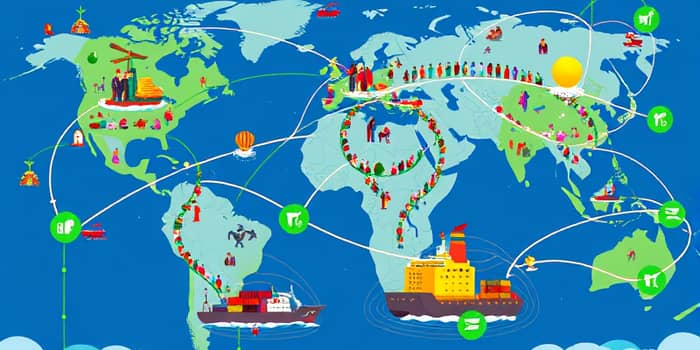
In 2025, global trade soared to unprecedented heights, eclipsing the record $35 trillion milestone with a remarkable 7 percent uptick. This landmark achievement set a new precedent for international commerce, underscoring the intricate links between economies, cultures, and emerging markets. As goods, services, and digital products traversed ever-expanding networks, stakeholders celebrated the resilience and adaptability demonstrated in the face of geopolitical headwinds and shifting policy landscapes.
Yet, while the triumph of 2025 framed a narrative of recovery and expansion, forecasts for subsequent years signal a moderation in momentum. Analysts project a slowdown to just 0.5 percent growth in trade volume for 2026, down from 2.4 percent the previous year. In this evolving context, business leaders, policymakers, and communities worldwide must recalibrate strategies to sustain progress and harness new avenues for cross-border collaboration.
At the heart of this dynamic lies a complex tapestry of macroeconomic forces. Global economic growth is expected to register a modest 2.6 percent in 2026, notably below pre-pandemic averages. Major economies such as the United States and China are experiencing diminished momentum, with growth forecasts of 1.5 percent and 4.6 percent, respectively. Under the most likely “multi-nodal trade patchwork” scenario, world goods trade could rebound to an annual pace of 2.5 percent through 2034, expanding from roughly $23 trillion to nearly $30 trillion in value.
Developing economies excluding China are projected to slow to 4.2 percent growth, underscoring the need for targeted reforms. In this context, tailoring fiscal and monetary policies to bolster domestic demand and export competitiveness becomes imperative. When advanced markets exhibit weak consumption, emerging regions must forge internal linkages and explore niche markets to sustain momentum.
This scenario envisages a more dispersed architecture of trade, characterized by four primary nodes: the United States, China, plurilateralists, and BRICS+ nations. Each node operates under distinct policy regimes, tariff structures, and strategic priorities, reflecting the fragmented yet interconnected nature of contemporary commerce. Stakeholders who decipher these patterns and embed geopolitics within decision frameworks will be best positioned to navigate the next decade of cross-cultural exchange.
One of the most striking developments in recent decades has been the surge of South-South trade. Merchandise exports between developing economies skyrocketed from $0.5 trillion in 1995 to $6.8 trillion in 2025, marking a thirteenfold increase. Today, 57 percent of developing-country exports flow to other emerging markets, a dramatic rise from 38 percent three decades ago. In Africa alone, more than half of exports now target fellow developing regions, fueled by the expansion of regional value chains in East and Southeast Asia.
The four-node trade structure encapsulates this diversity of approaches and trajectories:
This evolving mosaic of trade nodes highlights the interplay between national policies and regional alliances. As economies opt for strategic neutrality or deeper integration, the balance of influence shifts, offering both challenges and opportunities for exporters, investors, and local communities.
Beyond tangible goods, services now account for 27 percent of global trade and grew by approximately 9 percent in 2025, far surpassing the pace of merchandise. Digital solutions underpin 71 percent of intermediate inputs worldwide, powering manufacturing, logistics, finance, and healthcare. As services gain prominence, the digital divide emerges as a critical hurdle for equitable growth.
Closing the digital divide is not merely a technological imperative but a strategic one. By investing in broadband networks, educational programs, and regulatory frameworks, developing countries can unlock the fastest-growing segment of trade and ascend value chains.
Nearly two-thirds of global trade flows within complex value chains, from raw materials to finished goods. Recent geopolitical tensions and policy shifts have prompted firms to reorganize these networks, seeking a delicate balance between risk mitigation and operational efficiency. New hubs and alternative routes are emerging, reshaping logistics corridors and redefining traditional supply links.
Since 2020, industrial policy measures driven by national security concerns have surged, increasing more than sixfold. Over 18,000 discriminatory trade measures have been introduced, reflecting the growing emphasis on domestic resilience. As companies reassess localization strategies, countries with robust infrastructure, stable policies, and skilled workforces stand to attract significant investment.
In this era of fragmentation, the ability to pivot and adapt supply chains is essential for sustained competitiveness and growth.
Climate imperatives and environmental policies are reshaping the contours of cross-cultural trade. Enhanced climate pledges by 113 countries could slash global emissions by 12 percent by 2035, amplifying demand for clean-energy technologies. Markets for green goods and services may reach $640 billion annually by 2030, sparking new trade opportunities and investment streams.
Meanwhile, regulatory measures such as the European Union’s carbon border mechanism, set to take effect in 2026, will redefine market access and competitive dynamics. Technical regulations, sanitary standards, and carbon tariffs now influence approximately two-thirds of world trade, imposing substantial compliance costs, particularly on smaller exporters and lower-income economies. Navigating this regulatory maze requires a proactive approach to supply chain audits, certification processes, and sustainability reporting.
Global trade is undergoing a profound reorganization rather than a retreat. Geopolitical fragmentation coexists with deep interdependence, giving rise to a new patchwork of alliances and linkages. Leaders who integrate geopolitical risk into their strategic planning and cultivate cross-cultural partnerships will be best equipped to thrive in this multifaceted landscape.
By championing inclusive policies, diversifying partnerships, and adopting cutting-edge technologies, stakeholders can unlock new growth pathways and mitigate risks. Ultimately, transcending borders in the spirit of collaboration, innovation, and sustainability will shape the next chapter of international trade, delivering shared prosperity and mutual understanding across cultures.
References