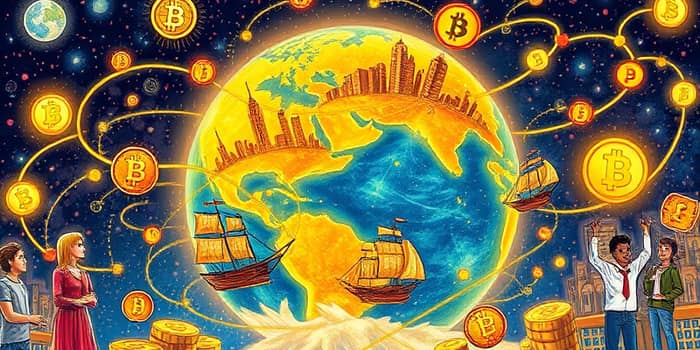
In a world where money moves fast, understanding its journey reveals the power of innovation and resilience. From humble beginnings in 17th-century ports to a vast digital realm, global finance has continuously adapted, shaping societies and economies. This article embarks on a detailed exploration, blending history with forward-looking insights, to inspire and empower readers seeking practical understanding and strategic vision.
The genesis of modern financial systems can be traced to Europe’s bustling trade hubs. In the early 1600s, merchants in Amsterdam and London pioneered instruments that would lay the bedrock for future markets. The Dutch East India Company issued the first shares and bonds, allowing investors to fund voyages and share in profits. Concurrently, bills of exchange and promissory notes emerged, facilitating cross-border commerce and extending credit to merchants.
These innovations introduced the concept of dispersed ownership and credit, forming the foundation of modern capitalism. They enabled economies to mobilize resources beyond local limitations, setting the stage for future waves of globalization.
The late 19th century witnessed the first significant wave of financial globalization. Between 1870 and 1914, unprecedented capital flows fueled industrial expansion across continents. London reigned as the premier financial center, followed by growing hubs like New York and Berlin. Free trade treaties, such as the UK-France Cobden–Chevalier Treaty, reduced barriers and spurred commerce.
This era exemplified unprecedented capital flows and trade. Railroads, steamships, and telegraph networks accelerated the movement of goods, people, and information, knitting together distant economies into an integrated system.
The Gold Standard dominated global finance from the late 19th century until World War I. Currencies were pegged to gold, ensuring fixed exchange rates and trade stability. However, the turmoil of the wars and the Great Depression strained this model. Protectionism surged, and foreign exchange markets became paralyzed.
In 1944, the Bretton Woods Conference introduced a new paradigm: currencies were pegged to the US dollar, itself convertible to gold at $35 per ounce. The International Monetary Fund (IMF) and the World Bank emerged to oversee this arrangement, offering loans and guidance to stabilize economies.
By 1971, the system collapsed with the Nixon shock, ending gold convertibility. The ensuing decades transitioned to floating exchange rate regimes, offering countries autonomy over monetary policy while exposing them to currency volatility.
Europe’s response to economic fragmentation was ambitious integration. Following attempts like the “Snake in the Tunnel,” the 1979 European Monetary System (EMS) introduced the ECU and convergence indicators to align member currencies. The 1992 Maastricht Treaty cemented a roadmap to Economic and Monetary Union (EMU), culminating in the euro’s launch in 1999 and the establishment of the European Central Bank in 1998.
This initiative created one of the world’s largest currency unions, illustrating the potential of interconnected global financial markets to enhance trade and political cooperation. Yet it also revealed challenges in coordinating fiscal policies across diverse economies.
The turn of the 21st century ushered in the internet age, transforming how individuals interact with financial markets. Online brokers like E*TRADE and Fidelity empowered retail investors with real-time trading platforms. Mobile banking and digital payments further democratized access, allowing millions to manage accounts and make transactions via smartphones.
This digital banking revolution democratized finance also laid the groundwork for fintech innovations that continue to reshape the ecosystem.
Financial history is punctuated by crises that test and reform the system. The Great Depression of the 1930s highlighted the perils of protectionism and unregulated markets. The oil shocks of the 1970s tested monetary regimes, leading to inflationary spirals and policy realignments. The 1997 Asian Financial Crisis and the Latin American debt crises of the 1980s underscored the dangers of volatile capital flows and inadequate oversight.
The most recent upheaval, the 2008 Global Financial Crisis, was precipitated by complex derivatives and structured products. Between 2002 and 2007, cross-border capital flows in short-term instruments exploded from $3 trillion to $11 trillion, amplifying systemic risks. In its aftermath, regulators worldwide tightened capital requirements and introduced stress tests to bolster resilience.
These upheavals underscore the importance of systemic vulnerabilities and risks in a globally connected financial system.
The post-2008 era has seen remarkable innovation. Fintech startups harness mobile payments, peer-to-peer lending, and digital wallets to lower costs and increase access. Blockchain technologies and cryptocurrencies propose an alternative architecture, promising decentralized financial networks and services that could transform payments, contracts, and asset custody.
Meanwhile, central banks explore digital currencies, and institutions like Euroclear discuss integrating blockchain into clearing systems. Artificial intelligence and big data analytics are enhancing risk management and personalized financial services.
As global capital markets evolve, fostering resilient global financial infrastructure will be crucial to balancing innovation with stability. Policymakers, regulators, and private actors must collaborate to manage risks and harness opportunities.
The journey from 17th-century trade finance to a complex digital ecosystem reflects humanity’s ingenuity and adaptability. Each milestone—whether the Gold Standard, Bretton Woods, or the rise of fintech—has reshaped how we transfer, invest, and safeguard wealth across borders.
By understanding this rich tapestry, stakeholders can navigate future challenges and drive inclusive, sustainable growth. Embracing innovation while learning from past crises will ensure that global financial ecosystems continue to empower communities and foster prosperity.
References