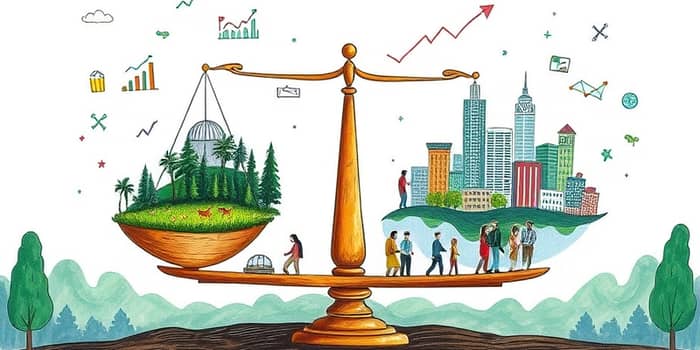
For generations, Gross Domestic Product has been the shorthand for national success. Yet GDP’s focus on market transactions leaves out critical aspects of human life and nature. As economies evolve, the need to capture a richer picture of prosperity becomes ever more urgent.
Innovators around the world are championing broad societal and environmental well-being as the new frontier of economic measurement. By looking beyond the narrow lens of monetary output, they seek to illuminate the full tapestry of progress.
GDP’s strength in tracking production also becomes its greatest weakness when addressing ecological concerns. Activities that harm ecosystems—deforestation, mining, overfishing—appear as economic gains without accounting for long-term losses. In effect, GDP counts both creation and destruction equally, masking environmental degradation and resource depletion.
Another blind spot is social equity. National GDP figures aggregate wealth without revealing who benefits most. Behind high-level numbers, hidden social and regional inequalities can widen, leaving communities and demographics at risk of exclusion.
Equally significant is the omission of care and volunteer work. Unpaid labor in homes and community settings adds real value that GDP ignores. Recognizing unpaid household and volunteer work would dramatically reshape our understanding of economic contribution and resilience.
Finally, as data becomes the currency of the digital age, traditional GDP metrics undervalue online platforms that offer free or low-cost services. The economic impact of personal data exchanges rarely appears in monetary measurements, creating a blind spot in policy debates.
Despite these shortcomings, GDP persists in policymaking and public discourse for practical reasons. It is relatively simple to compute, universally reported, and provides a common language for comparing economies across borders and through time.
For short-term analysis of market activity, GDP remains a useful, if limited, indicator. However, its narrow focus calls for complementary measures that capture a fuller vision of societal health.
In response to GDP’s blind spots, scholars and policymakers have proposed a suite of pioneering metrics. Each offers a unique lens on prosperity, balancing economic performance with human and environmental concerns.
These alternatives challenge conventional wisdom by seeking to embed long-term sustainability considerations into the heart of economic analysis.
To illustrate how these metrics differ, consider the following overview:
Rather than abandoning GDP entirely, many communities adopt a mosaic of indicators. This mixed strategy reveals hidden relationships and guides balanced policymaking.
By aligning multiple measures, cities can map the connections between consumption, social equity, and ecological pressures in a single dashboard.
The movement to transcend GDP has gained official traction. In 2024, the United Nations appointed a High-Level Expert Group to craft new metrics under the banner of the Sustainable Development Goals. Similarly, academic leaders like Nobel laureate Joseph Stiglitz championed parallel frameworks that emphasize human and environmental well-being.
International bodies—the OECD, the European Commission, and countless research institutes—are now collaborating to establish standard guidelines. Their work aims to ensure that new indicators are robust, transparent, and comparable across nations and cultures.
Cities and regions can pioneer these innovative metrics to deepen public understanding of prosperity. By reporting beyond-GDP indicators, governments can:
- Redefine success to include health, fairness, and environmental stewardship.
- Guide investments toward community-based services and natural capital restoration.
- Foster partnerships among public, private, and civic sectors to align goals and share data.
Embracing a multidimensional framework empowers citizens to engage in policy debates with richer, evidence-based narratives. It also equips leaders to allocate resources where they deliver the greatest collective benefit.
The quest of the movement to transcend GDP is more than an academic exercise; it is a pathway to a more equitable and resilient world. By integrating diverse measures of success, societies can ensure that growth truly reflects the well-being of people and the planet.
As governments, institutions, and communities adopt these pioneering frameworks, they demonstrate a commitment to redefining progress. The journey ahead promises to transform public policy debates and chart a course toward authentic, enduring prosperity for all.
References