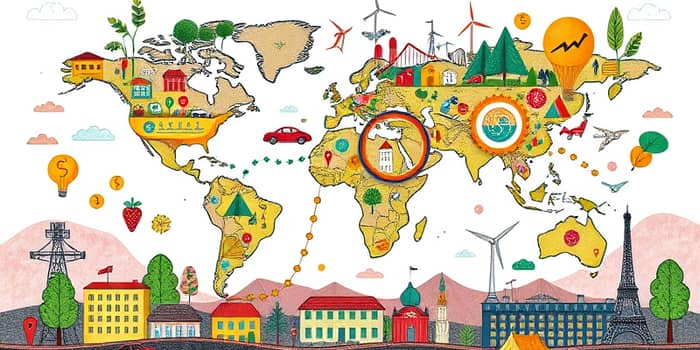
The numbers guiding our view of the world economy for 2026 offer both promise and caution. As experts debate projections, a deeper look reveals the need to measure progress beyond mere output. This article unpacks forecasts, critiques GDP’s blind spots, and highlights alternative metrics driving sustainable, inclusive growth.
Multiple institutions predict varying outcomes for world GDP in 2026. These estimates reflect a mix of optimism from innovation and lingering headwinds.
While the IMF foresees a robust 3.3% expansion fueled by tech investment, UN DESA’s more cautious 2.7% estimate underlines fiscal constraints. The divergence stems from assumptions about trade tensions, climate shocks, and policy support.
The range—from 2.6% to 3.3%—reflects both optimism for resilience from technological innovation and concerns over debt and climate shocks.
Growth will be uneven, with emerging markets outpacing mature economies. Key regional forecasts include:
These disparities emerge from policy frameworks, demographic dynamics, and exposure to global shocks. For instance, tariff shifts in the US and Europe contrast with sustained consumer demand in South Asia.
GDP remains the gold standard for measuring economic activity, but it omits key facets of societal well-being. By focusing solely on production, GDP ignores:
Historically, global GDP has soared from USD 4.5 trillion fifty years ago to nearly USD 100 trillion today, while median incomes rose just 150% since 1985. Too often, rising output coincides with inequality, informality, environmental degradation and concentrated wealth.
Recognizing these blind spots, economists and policymakers champion alternative indicators that integrate social and environmental dimensions.
Key metrics gaining traction include:
These tools strive to capture well-being, sustainability, and inclusivity—highlighting that true prosperity depends on healthy communities and healthy ecosystems.
The UN’s High-Level Expert Group on Beyond GDP frameworks advocates for composite indices tied to the Sustainable Development Goals. By linking economic planning to human rights, climate action, and equality, governments can pursue sound policy frameworks and cooperation that foster resilience and fairness.
National and subnational governments in Hawaii, Maryland, and parts of Europe have piloted the GPI, redirecting budgets toward renewable energy, education infrastructure, and social safety nets. Such experiments demonstrate that prioritizing quality of life alongside growth can yield stronger long-term outcomes.
Looking forward, the global economy faces both upside and downside scenarios:
As the world navigates these crossroads, decision-makers must weigh immediate output gains against lasting social and environmental capital. Embracing human flourishing beyond mere output will require innovation in measurement, policy coherence, and collaborative governance.
GDP forecasts for 2026 provide valuable benchmarks, but they tell only part of the story. To build economies that endure and uplift all people, we need metrics that mirror our values and aspirations.
By integrating alternative indicators and championing policies that balance growth with well-being, we can transform raw numbers into narratives of shared progress. In doing so, we move beyond the headlines and toward a world where prosperity is measured in lives enriched, communities strengthened, and the planet preserved.
References