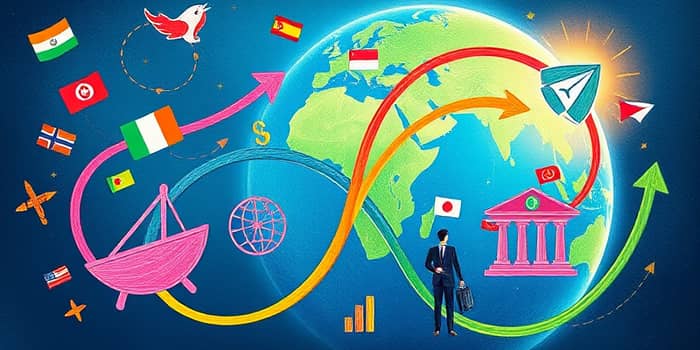
International capital flows are the paid transfer of monetary capital rights between countries, representing the financial counterpart to global trade. As funds move across borders, ownership of assets shifts, financing development, bridging imbalances, and shaping economic landscapes.
These movements occur through a range of mechanisms, from direct investments to speculative trades, each influencing currency values, domestic credit conditions, and long-term growth trajectories. Understanding the dynamics behind these flows empowers policymakers, investors, and businesses to harness benefits while mitigating risks.
At its core, a capital flow involves residents of one country transferring financial assets to another, where they assume ownership rights. Such flows offset trade imbalances: a current account deficit must be matched by a capital account surplus, illustrating the double-entry nature of modern balance of payments.
Beyond accounting, capital flows drive drive global economic integration by channeling funds to regions with high growth potential or profitable opportunities. They foster technology transfer, infrastructure development, and employment, while also introducing vulnerabilities when rapid reversals occur.
Capital flows can be broadly sorted by their duration and intent:
The main components include:
Several theoretical frameworks explain why capital crosses borders:
Multiple economic, political, and institutional factors determine the scale and direction of capital movements:
For example, a country with robust institutional framework and transparency is more likely to attract sustainable inflows, while those with erratic policy shifts or geopolitical tensions face volatile withdrawals.
Capital flows bring both opportunities and challenges for emerging and developed economies alike. On the positive side, they:
However, unchecked inflows and sudden outflows can:
Prudent management of capital flows requires a balanced approach combining liberalization with safeguards. Key strategies include:
Moreover, fostering liquidity, integration, and transaction cost reduction through advanced digital platforms can enhance market efficiency and resilience against shocks. Transparent data-sharing mechanisms help regulators respond swiftly to emerging imbalances.
Historical episodes—from the Latin American debt crises of the 1980s to the Asian financial turmoil of the late 1990s—underscore the importance of preparedness. Nations that combined open capital accounts with strong macroeconomic fundamentals and institutional backing weathered storms more effectively.
Looking ahead, global patterns suggest that banking networks, with their “excess elasticity,” will continue to dominate non-physical financing. Meanwhile, evolving digital currencies and decentralized finance platforms may reshape traditional corridors of capital movement.
Understanding these trends empowers policymakers and market participants to craft informed strategies, aligning national growth objectives with global investment flows. By calibrating interest rates, regulatory stances, and macroprudential tools, countries can harness capital movements to fuel sustainable development rather than succumb to disruptive volatility.
As capital courses through global markets, the journey is guided by an intricate web of economic stimuli, institutional safeguards, and investor psychology. Embracing this complexity with foresight and adaptability is the key to unlocking the full potential of international finance for the collective prosperity of nations.