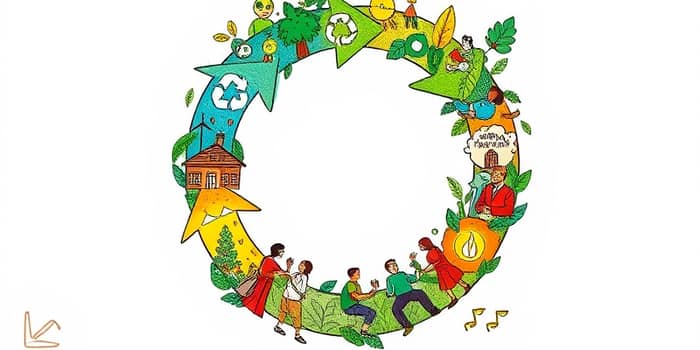
In an era of shrinking resources and overflowing landfills, the circular economy shines as a path toward sustainable prosperity. It calls us to rethink design, consumption, and systems so that materials never lose their value.
By shifting from a wasteful linear model to regenerative loops, we unlock environmental, economic, and social gains that benefit all.
The circular economy is a regenerative system that reduces waste by keeping materials in use through every stage of their life. It rejects the "take-make-waste" paradigm in favor of closed-loop processes that integrate multiple stages from extraction to renewal.
At its heart are strategies to make, use, collect, transform, reuse goods, ensuring resources cycle continuously rather than end up in landfills.
Leading experts outline three pillars that shape a resilient, circular world:
These pillars rest on data-driven feedback loops and collaborative networks that track materials and unlock new business models.
Comparing the two approaches reveals why circularity is transformative:
Transitioning to circularity unlocks quantifiable rewards. Globally, greenhouse gas emissions can drop by 33%, while waste management processes see reductions up to 52%. In construction alone, material changes could save 6.8 Gt CO2e by 2050.
Economic incentives are equally powerful: secondhand and rental markets are booming, creating up to 8 million new jobs and providing supply chain security. Meanwhile, 91% of extracted materials that once became waste are reimagined as valuable resources.
The principles of circularity take shape differently across industries:
Together, these applications weave a tapestry of resourcefulness that benefits people and planet alike.
Transforming vision into reality demands coordinated action across business, technology, policy, and culture. Key strategies include:
By integrating these elements, organizations can build resilient systems that adapt and thrive.
Despite its promise, circularity faces hurdles: inconsistent metrics, low recycling rates, and limited global monitoring hinder progress.
Developing standardized monitoring and reporting is essential to track progress and enable transparent comparisons across regions and sectors.
Building advanced sorting and recovery infrastructure can maximize material yields and reduce contamination in recycling streams.
Integrating circular economy scenarios into models guides better decision-making in climate and economic forecasting.
The circular economy represents more than an economic model; it is a collective vision of shared prosperity and environmental stewardship. Every stakeholder—policy maker, entrepreneur, consumer—plays a pivotal role in redesigning systems that nurture rather than deplete.
Embrace circular design, support reuse platforms, and advocate for policies that embed regeneration at their core. Together, we can forge a resilient future where resources flow in endless loops, driving innovation, equity, and planetary health.
References