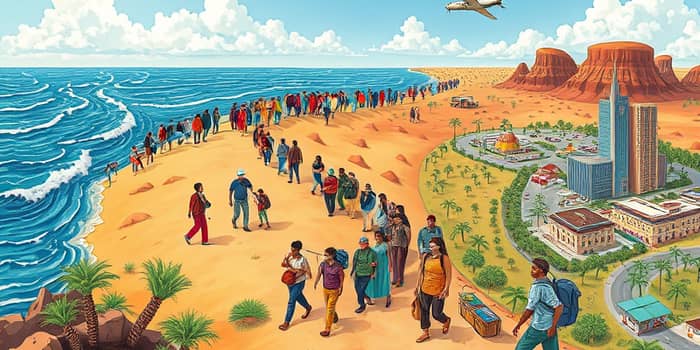
Climate-driven displacement is reshaping communities worldwide, presenting both hardships and potential economic gains. As millions move to escape rising seas, extreme heat, and drought, host societies face disruption but also stand to benefit from new skills and innovation. This article explores the dual nature of climate migration and offers practical insights for harnessing its positive potential.
By 2050, up to 216 million people could become internal climate migrants across six major regions if global warming continues unchecked. Sub-Saharan Africa faces the highest numbers, with an estimated 86 million displacements by mid-century.
Today, ~75.9 million people are internally displaced, including 7.7 million fleeing disasters. Between 1995 and 2024, over 832,000 lives were lost to climate risks, underscoring the human toll driving migration patterns.
Initial influxes can strain housing markets and job sectors. Rents may spike, and competition for low-skill positions can suppress wages for local workers. Financial services become overloaded as demand for credit and social safety nets rises.
Healthcare and education systems may face overcrowding, while local governments scramble to expand infrastructure. Non-state groups can exploit resource scarcity, heightening social tensions if integration is poorly managed.
Over the medium to long term, migrants bring fresh dynamism. They are often entrepreneurial, more likely to start businesses, which spurs job creation and lifts local wages. Their labor can fill critical gaps in the emerging green economy, addressing a projected 7 million worker shortfall by 2030.
In regions impacted by natural disasters—such as Central Florida after Hurricane Maria—an influx of migrants boosted consumption and revitalized local markets. Remittances to origin communities fund health, education, and small enterprises, reducing poverty and enhancing resilience.
While the initial pressures on labor, housing, and services are real, historical patterns demonstrate that economies adjust. In many cases, what begins as disruption evolves into robust growth, with migrants filling key niches and expanding tax bases.
Sub-Saharan Africa’s Sahel region illustrates extreme slow-onset displacement due to desertification. Conversely, Pacific Islands confront permanent losses from sea-level rise, prompting international relocation efforts.
In Bangladesh, internal migration from flooded farmlands to Dhaka has both alleviated rural poverty and fueled urban sprawl. Central American droughts drive northward moves to the United States, where policy shifts and economic viability shape future flows.
Innovative partnerships, such as the Colombia–Spain Temporary Circular Labor Migration pilot, show how structured pathways can support recovery in disaster-affected areas while supplying workforce needs abroad.
Proactive policies can smooth integration and amplify benefits. Key measures include:
Public–private partnerships can finance infrastructure upgrades, while community-based initiatives foster social cohesion. By framing climate migration as an adaptation strategy, governments can channel resources into workforce training, business incubation, and resilient city planning.
Climate migration is neither solely a humanitarian crisis nor purely an economic burden. It embodies a complex transformation with immediate challenges and enduring promise. By adopting inclusive, forward-looking policies, societies can harness the entrepreneurial spirit and labor of migrants to drive sustainable growth.
With thoughtful planning, investment in social infrastructure, and a commitment to equity, climate migration can be a powerful tool for adaptation, delivering resilience and prosperity for both newcomers and host communities alike.
References