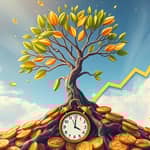
In today’s interconnected world, trust has transcended words and handshakes to become a cornerstone of economic power. Organizations and individuals alike find their fortunes rising or falling on the currency of reputation. By viewing reputation as a form of capital, we can unlock strategies to build, protect, and leverage this intangible asset.
Reputation is no longer just a matter of prestige or goodwill; it functions as measurable financial capital on modern balance sheets. In the emerging reputation economy, online visibility and public perception amplify the influence of trust. Businesses with high standing command premium pricing, enjoy accelerated growth, and secure preferential investment. Individuals who curate respected personal brands can charge 15-25% higher consumer rates and win larger contracts in B2B markets.
Consider this startling figure: reputation constitutes 28% of the S&P 500’s market cap—equivalent to $11.9 trillion in 2024. When reputation improves by just 5%, average market capitalization climbs an additional 3%. Such data reveal trust as a strategic lever for competitive advantage.
Economists employ rigorous models to isolate the monetary effects of reputation. The Reputation Dividend Model uses econometric regression to demonstrate how dimensions like ethics, innovation, and workplace culture drive share prices. Charles Fombrun’s Reputation Quotient evaluates 11 factors—product quality, leadership, social responsibility—and links them to sustained revenue growth.
Below is a comprehensive snapshot of reputation metrics impacting market value:
Reputation converts into economic returns through several key pathways. Understanding and optimizing these mechanisms can magnify the benefits of trust.
Additional benefits include improved customer retention, reduced marketing spend through word-of-mouth, and stronger crisis resilience.
Several theories illuminate how reputation operates as capital. Signaling theory explains how high prices communicate quality, reinforcing perceived value. The NYU Stern primer introduces a “bootstrap” mechanism: firms build trust by delivering quality first, then leverage positive outcomes to command higher prices, shifting from a "trust phase" to a "punishment phase" if failures occur.
Game theory experiments in repeated Prisoner’s Dilemma settings reveal that participants with better reputations cooperate more often, and markets price this cooperation at a significant premium. These findings underscore the enduring value of consistent, trustworthy behavior.
Reputation manifests in multiple forms. Economic reputation signals market differentiation and is measured by rankings and financial performance. Societal reputation reflects legitimacy, visibility, and stakeholder perception. Managers view reputation as an aggregation of audience judgments about behavior and capabilities, shaped by media, reviews, and even Wikipedia entries.
Famed investor Warren Buffett reminds us: “It takes 20 years to build a reputation and five minutes to ruin it.” This asymmetry highlights the precious nature of trust and the fragility of its foundation. Charles Fombrun’s pioneering 1996 work on the Reputation Quotient laid the groundwork for systematic measurement, while evolutionary game theory affirms that investments in reputation yield future payoffs through indirect reciprocity.
Reputation strategies extend far beyond corporate boardrooms. Individuals can cultivate personal brands that command higher fees and attract lucrative opportunities. Companies can integrate reputation metrics into strategic planning, aligning innovation, ethics, and culture to elevate standing.
By viewing trust as a strategic asset, decision-makers can allocate resources more effectively, targeting the drivers that yield the highest reputation dividends.
Despite its benefits, reputation is vulnerable to rapid erosion. Scandals, miscommunication, or perceived hypocrisy can trigger steep declines in trust. Experimental research shows markets may underprice reputation when short-term metrics dominate decision-making, creating opportunities for undervalued competitors.
To mitigate risks, organizations must monitor reputation indicators continuously, respond transparently to crises, and maintain consistency between stated values and actions. Only through sustained effort can reputation serve as a stable driver of economic success.
In the reputation economy, trust is the ultimate capital—an intangible asset with tangible returns. By quantifying its impact, understanding its mechanisms, and learning from theory and history, we can craft intentional strategies to build and protect our reputations. Whether you are an entrepreneur, executive, or citizen in a global marketplace, embracing reputation as economic capital empowers you to unlock growth, forge stronger relationships, and leave a legacy of integrity.
References