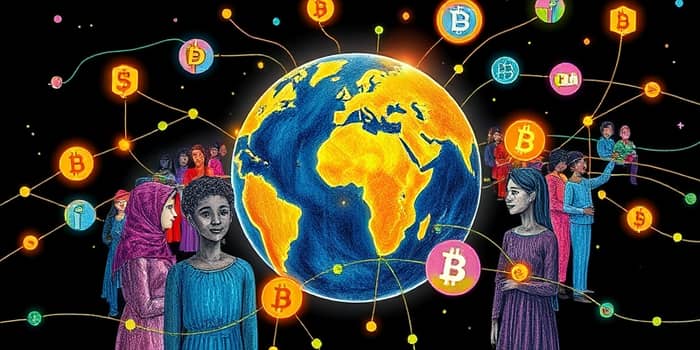
Decentralized finance, commonly known as DeFi, is revolutionizing the way we think about money, banking, and economic empowerment. Emerging from the principles of blockchain, DeFi unlocks the possibility for millions of people—ranging from freelance creatives in São Paulo to startup incubators in Nairobi—to access financial services once reserved for established institutions. At its heart, DeFi offers user-controlled financial tools designed for transparency and global reach.
Rather than relying on banks or centralized intermediaries, DeFi platforms leverage smart contracts on networks like Ethereum, enabling programmable transactions that execute automatically when predefined conditions are met. This model fosters peer-to-peer transactions and public, verifiable on-chain transactions, eliminating paperwork, reducing fees, and accelerating settlement times. As DeFi continues to mature, it promises a future where finance is more inclusive, efficient, and resilient.
At its core, DeFi comprises a suite of financial services—lending, borrowing, trading, derivatives, and insurance—built on programmable, permissionless blockchains. Users interact through non-custodial wallets, retaining full control over their assets without trusting a centralized entity. Smart contracts serve as transparent, immutable agreements, executed instantly and recorded on a public ledger for anyone to audit.
This paradigm shifts power from corporate balance sheets to individual wallets, challenging centuries-old banking practices. No longer must users wait days for cross-border transfers; DeFi protocols facilitate near-instant settlement. No longer are interest rates dictated behind closed doors; algorithmic market forces set rates in real time. The result is a dynamic, open financial ecosystem accessible to anyone with an internet connection.
From its origins in decentralized exchanges to complex yield optimization strategies, DeFi has experienced exponential growth. As of 2023, the total value locked in DeFi protocols surpassed USD 52 billion, reflecting surging interest and capital inflows. Market research projects values between USD 42 and 44 billion by 2025, rising to over USD 60 billion by 2026, with some estimates suggesting market caps above USD 1.4 trillion by 2033.
These projections are anchored by a robust compound annual growth rate, ranging between 40 and 68 percent, depending on the source and forecast horizon. North America currently leads with a 36 percent share of global revenue, while Asia and Europe rapidly expand their DeFi ecosystems through developer communities, regulatory sandboxes, and institutional partnerships.
DeFi’s modular architecture allows distinct protocols to interoperate, creating a composable “money legos” environment where developers combine existing building blocks to create novel financial products. Key components include:
Ethereum’s smart contract capabilities have cemented its dominance, accounting for over 58 percent of all DeFi liquidity. The network hosts hundreds of interoperable protocols and millions of daily transactions, while developer tooling like MetaMask and Infura powers user adoption and scalability. Layer 2 solutions, such as Optimism and Arbitrum, further enhance throughput and reduce fees, enabling DeFi use cases to flourish at scale.
The revolutionary potential of DeFi becomes clear when pitted against centralized finance. Traditional systems require trust in institutions, rely on opaque processes, and often exclude unbanked populations. In contrast, DeFi offers a transparent and inclusive model. The following table highlights critical differences:
Beyond technical specifications, DeFi holds the promise of democratizing finance. In regions with unstable currencies, users deploy stablecoins to protect savings from inflation. In underserved markets, entrepreneurs secure microloans without lengthy approval processes. Imagine artisans in remote areas tokenizing their crafts to raise capital or migrants sending remittances in minutes with minimal fees. Each real-world application represents a step toward financial equity.
Nonprofit organizations and social enterprises are building DeFi-based lending platforms to support small businesses in developing economies, demonstrating how technology can catalyze grassroots growth. As protocols become more user-friendly, these models will scale, uplifting communities while fostering global financial resilience.
For newcomers, the DeFi landscape can feel overwhelming. However, adopting a structured approach ensures safer engagement and maximizes opportunities:
While DeFi offers innovation, it also presents unique risks. Smart contract bugs, flash loan exploits, and rug pulls underscore the need for caution. Regulatory clarity is evolving: some countries embrace sandbox programs, while others impose strict licensing requirements. Users must stay informed about jurisdictional policies and consider protocols with robust compliance features.
Institutions are increasingly entering the space, seeking to offer compliant on-ramps and custody services. Their participation may accelerate the development of increased regulatory clarity and foster trust among mainstream investors, further fueling DeFi's expansion.
The next wave of DeFi will integrate real-world assets—real estate, art, commodities—into tokenized ecosystems, bridging the gap between legacy finance and blockchain-based markets. Interoperable cross-chain protocols will allow assets to move seamlessly, unlocking new liquidity pools and fostering global financial connectivity.
Developers will continue to refine user interfaces, abstracting complex blockchain mechanics and making DeFi accessible to non-technical users. Community-driven governance models will evolve, balancing decentralization with effective decision-making to navigate regulatory pressures and market volatility.
As DeFi journeys through cycles of innovation and adoption, its core promise remains unchanged: a financial system that is open, transparent, and equitable. By embracing this vision, we can collectively build a resilient global economy—one block, one contract, and one empowered user at a time.
References