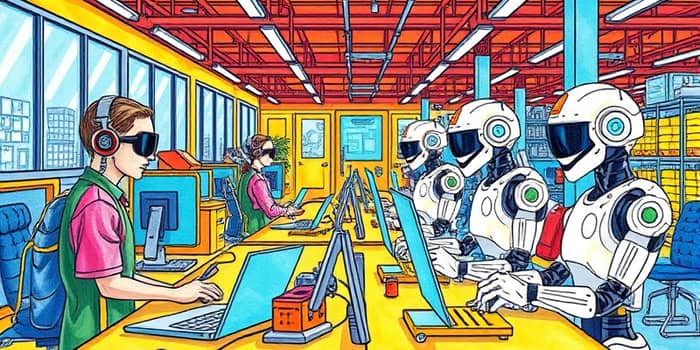
The rapid rise of generative AI since 2022 has sparked both optimism and concern about its impact on global labor markets. While total U.S. employment has grown, pockets of displacement and wage shifts signal a complex future for workers at every skill level. Navigating this landscape requires understanding the numbers, distinguishing automation from augmentation, and preparing for a workforce transformed by intelligent machines.
Since the launch of ChatGPT in fall 2022, total U.S. employment increased 2.5%, even as job counts in the computer systems design sector fell by 5%. In the 10% of sectors most exposed to AI, employment dipped by 1%. Estimates suggest that 14–30% of jobs face displacement in coming years, potentially impacting up to 80% of the American workforce in some form.
Large language models predict 3–6% of U.S. workers could be displaced within 1–3 years, rising to 10–15% over the next decade. Anthropic’s CEO warns that half of entry-level white-collar roles may be disrupted within five years, possibly pushing unemployment to 20%, surpassing levels seen in the Great Financial Crisis of 2009.
At the heart of AI’s labor impact lies a tension between automation and human augmentation. AI excels at codified tasks—those based on rule sets and replicable patterns—making it a direct substitute for entry-level positions in customer service, data entry, and routine programming.
Conversely, AI amplifies roles requiring deep experience and contextual judgment. Evidence shows occupations with high experience premiums—often exceeding 100% in fields like law and insurance underwriting—can see wage growth bolstered by AI tools that streamline research and analysis.
AI’s footprint varies widely across industries and age groups. Young workers under 25 suffer the most from hiring slowdowns in AI-exposed fields. Low job-finding rates rather than layoffs drive this decline, undermining traditional career ladders that begin with codified tasks and lead to tacit learning.
In contrast, experienced professionals in high-premium occupations benefit from AI-powered insights. A one-standard-deviation rise in AI exposure corresponds with a 0.2 percentage point increase in wage growth for those at the 90th percentile of experience premiums. Those at the median see negligible impacts, while low-premium roles suffer a -0.28 point decline.
Across Canada, 57.4% of jobs were highly exposed to AI in 2024. Despite this, some AI-exposed occupations grew by 10–20%, underscoring that technological potential does not automatically translate into job losses. Rather, it reshapes demand toward new skill sets.
Industry surveys reveal 90% of organizations derive moderate or great value from AI, yet many initiate layoffs based on anticipated, not realized, efficiencies. PwC data confirms that workers with AI skills earn significantly higher wages across industries, highlighting the premium placed on adaptability and technical proficiency.
By 2026, a hypothetical “intelligence crisis” model projects U.S. unemployment at 4.28%, with AI capital expenditure at 2% of GDP—about $650 billion. AI-adjacent commodities have surged 65% since January 2023, reflecting investors’ confidence in the technology’s economic potency.
To navigate AI’s disruptive potential, stakeholders must adopt proactive strategies that balance displacement risks with growth prospects. Key recommendations include:
Such measures can smooth the shift toward a more automated economy while ensuring workers are equipped to harness AI as an augmenting force rather than a rival.
As businesses integrate AI into 86% of operations by 2030, the narrative will evolve from fear of job loss to opportunities for creative reinvention. Generative AI, machine learning, and advanced robotics will reframe roles, shifting emphasis from routine execution to strategic oversight and human-centric problem solving.
Employers who embrace this transformation can unlock unprecedented productivity gains, while employees who cultivate both technical prowess and emotional intelligence will command lasting value. The coming decade promises a redefined labor market—one where resilience, lifelong learning, and adaptability become the hallmarks of success in an AI-augmented world.
References