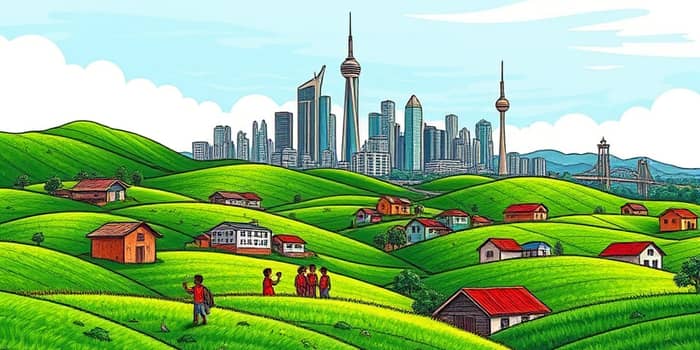
Development economics stands at the intersection of theory and action, seeking to understand how societies transform from stagnation to sustainable prosperity. It explores not only the quantitative aspects of economic growth and development but also the qualitative dimensions of well-being, dignity, and opportunity. In a time of rapid globalization, the lessons emerging from low- and middle-income countries resonate with policymakers, scholars, and practitioners worldwide.
Since the pioneering work of W.W. Rostow and Arthur Lewis in the mid-twentieth century, the field has evolved through neoclassical, dependency, and institutional frameworks. Today’s emphasis on computing power, microeconometric datasets, and randomized evaluations has given rise to a dynamic, evidence-driven discipline. By integrating both quantitative methods—such as intertemporal optimization—and qualitative insights from case studies, the field aims for comprehensive solutions.
This discipline is characterized by its multifaceted focus: it addresses poverty reduction and inequality measurement, champions investments in human capital and health improvements, and underscores the role of strong institutions and transparent governance in fostering stable environments. At its heart lies a commitment to environmentally sustainable and inclusive growth, ensuring that progress does not compromise ecological integrity or social equity.
At its core, development economics investigates the mechanisms by which countries transition from agrarian, low-income societies to diversified, high-income economies. This transformation involves not only boosting per capita GDP but also elevating living standards, expanding education, and improving healthcare delivery for the broader population.
The field distinguishes between growth—a purely numerical increase in output—and development, which encompasses structural change, poverty escape, and enhanced quality of life. Early models, such as Rostow’s five-stage trajectory and Lewis’s dual-sector framework, laid the groundwork for understanding how capital accumulation and labor shifts drive progress.
Success in development hinges on multiple interrelated pillars. Each pillar reinforces the others, creating virtuous cycles of investment, productivity, and human well-being.
By focusing on these pillars, policymakers can design holistic strategies that promote resilience and long-term prosperity. Each element requires careful calibration to country-specific contexts, resource endowments, and social dynamics.
Over decades, scholars have proposed diverse models to explain development trajectories. While some emphasize external dependencies and historical exploitation, others highlight market efficiency, endogenous innovation, or institutional incentives.
This comparative lens helps policymakers select strategies that align with national priorities. Emerging frameworks, such as the National Development Continuum Theory, advocate for non-linear paths that adapt over time and address high-income-context poverty as well.
Bridging academic insights with practical action requires targeted interventions and continuous evaluation. Development economists advise on macroeconomic stability, human capital formation, and structural reforms to catalyze inclusive growth.
Continuous data collection, rigorous impact evaluations, and stakeholder engagement ensure that policies remain adaptive and effective. Real-world experiments, from conditional cash transfers to microfinance pilots, demonstrate the power of evidence-based scaling.
Despite progress, development efforts face significant hurdles. Jobless growth, urban–rural inequality, and ecological pressures can undermine gains, demanding innovative solutions that balance speed with sustainability.
Developing nations must build adaptive capacities, diversify their economies, and invest in green infrastructure to thrive amid uncertainty. Collaboration among governments, civil society, and international organizations remains vital for sharing best practices and mobilizing resources.
Ultimately, development economics offers both a compass and a toolkit for guiding emerging nations toward equitable prosperity. By integrating structural reforms, human capital investments, and robust institutions, countries can chart resilient growth paths.
As the global community confronts challenges such as climate change, health crises, and technological disruption, the principles of development economics provide a blueprint for collective success. When grounded in rigorous analysis and committed leadership, these ideas can transform hope into lasting progress for millions worldwide.
References