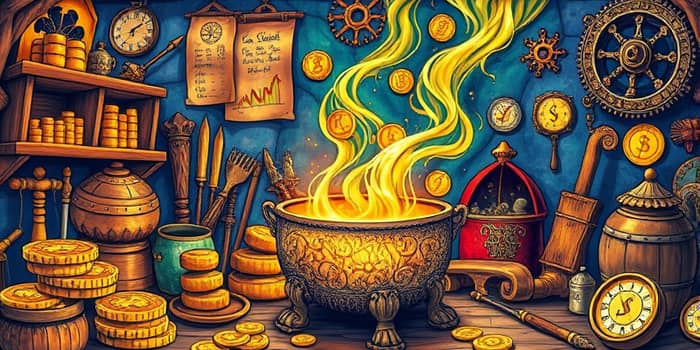
Throughout history, societies have sought magical solutions to material problems, from medieval alchemists chasing gold to modern thinkers reimagining money itself. Today, economic alchemy captures that same impulse: to turn constraints into catalysts for innovation and growth.
In this article, we journey from the alembics of 17th-century laboratories to today’s financial markets, uncover key theories, and offer practical tools so you can transmute scarcity to abundance in your own economic life.
In the 1600s, chemists and philosophers like Isaac Newton literally endeavored to convert lead into gold. Their failures, however, paved the way for new models of money.
After the Cromwellian era, English thinkers recognized that society was not a static pie but a dynamic system. They realized money supply needed to expand with production. When literal transmutation failed, credit emerged as a form of metaphorical alchemy, the true Philosopher’s Stone enabling perpetual trade.
Mercantilists once guarded gold and silver to preserve social hierarchies. Eventually, transparent banking practices—honest ledgers, elite oversight, and draconian fraud penalties—built trust. This shift from guarded treasure to circulating credit laid the groundwork for modern finance.
Investor George Soros introduced feedback loops and disequilibrium into economic thinking. In his theory of reflexivity, price and perception interact continuously, shaping reality rather than merely reflecting it.
By tracking divergences between sentiment and underlying data, adaptable investors spot emerging themes—semiconductor innovations, shifts in gold demand, or rare earth resource cycles—and position themselves ahead of the crowd.
Not all economists see money as alchemy. Modern Monetary Theory (MMT) argues that sovereign issuers can create currency at will, constrained by real resources, not arbitrary gold reserves. This approach echoes Keynes’ dictum, “Whatever we can do, we can afford.”
Under MMT, funding initiatives like clean rivers or universal healthcare depends on available labor, materials, and technology, not on tax revenues alone. While critics warn of inflationary risks, proponents view it as a pragmatic framework for public investment.
Perhaps the truest form of economic alchemy lies in innovation. Consider U.S. agriculture: in Lincoln’s era, nearly 90% of the population toiled on farms; today, fewer than 2% feed the entire nation. Advances in fertilizers, machinery, and logistics created abundance from scarcity.
Similar transformations unfold now as societies pivot from horse-drawn transport to electric vehicles, and as renewable energy scales. Human creativity continues to convert known limitations into new frontiers of possibility.
Beyond theories, individuals can harness simple practices to shift mindsets and behaviors. Treat your finances as a laboratory for experimentation, applying rituals and techniques that align your beliefs with your goals.
Concrete examples reveal how alchemical principles manifest in markets and industries.
Markets and economies are inherently uncertain. By adopting an adaptive growth mindset, you learn to pivot nimbly when conditions shift. Monitor thematic signals, stress-test assumptions, and position for catalytic events rather than chasing illusions of a “free lunch.”
Recognize that reversals are part of the process. Booms and busts, once seen as anomalies, are core to reflexive dynamics. Your challenge is to understand these cycles, not avoid them, and to harness momentum when it builds.
Economic alchemy isn’t about conjuring wealth from thin air; it’s about harnessing history’s lessons, cutting-edge theory, and personal agency to turn challenges into opportunities. Whether through credit innovations, policy frameworks, or individual mindset shifts, the power to transform lies within our collective ingenuity.
Begin by observing where perception diverges from fundamentals, by testing small experiments in your financial life, and by committing to continuous learning. In doing so, you become both the alchemist and the philosopher, ever striving to refine base challenges into enduring gold.
References