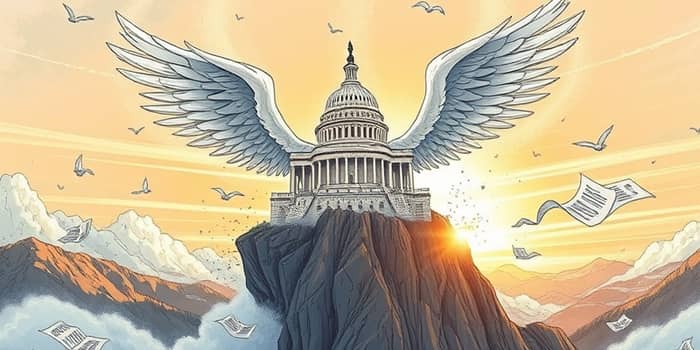
Balancing national budgets involves weighing long-term prosperity against short-term shocks. This guide explores how government spending decisions can either push an economy off a precipice or lift it toward growth.
The concept of a "fiscal cliff" gained prominence in 2012 when multiple tax increases and spending cuts were scheduled to hit simultaneously. Ben Bernanke warned of a massive fiscal cliff of large cuts that could tip the U.S. economy into recession overnight.
Earlier debates had labeled this potential shock a "fiscal slope" or "fiscal hill," suggesting a gradual impact rather than an abrupt fall. Nonetheless, the looming policy changes highlighted the delicate interplay between taxation, spending, and economic stability.
Several components were due to activate on January 1, 2013, under the Budget Control Act and prior tax legislation:
Absent intervention, the Congressional Budget Office projected a combined 19.6% revenue increase and 0.25% spending cut, slashing the deficit by over $560 billion in 2013 alone.
After intense negotiations, Congress passed the American Taxpayer Relief Act (ATRA), which:
This compromise reduced the immediate fiscal shock, cutting the deficit by about $157 billion instead of the projected $487 billion under the full cliff scenario.
Political leaders proposed a variety of measures, from raising the Medicare eligibility age to curbing cost-of-living adjustments in Social Security. These debates underscored how deeply policy design affects households across the income spectrum.
Fast forward to 2025, when the federal deficit stood at $1.8 trillion—4% lower than the prior year. Yet, projections show the deficit rising to 6.4% of GDP by 2028, driven by increased spending and slower revenue growth.
Key figures for the decade:
These trends spotlight the persistent disconnect between expenditures—especially on entitlement programs—and the tax base that funds them.
Understanding fiscal multipliers helps gauge the real impact of spending decisions:
Meanwhile, tariffs introduced since 2025 are forecast to reduce deficits by nearly $3 trillion over ten years but at the cost of 0.6% lower real GDP growth and higher inflation.
Consumer outlays often determine whether fiscal policies lift or stifle growth. Current forecasts predict:
These shifts reflect base effects from prior years and mounting headwinds from tighter fiscal stance later in 2026.
Policymakers, business leaders, and households can adopt measures to navigate fiscal turbulence:
Such approaches promote smarter budgetary planning over time and reduce the risk of abrupt adjustments that shock markets and communities.
Whether an economy faces a fiscal cliff or enjoys fiscal flight depends largely on proactive planning and collaborative governance. By:
leaders can transform potential crises into opportunities for renewal. The journey demands courage to confront tough trade-offs and the vision to invest in long-term prosperity.
Fiscal policy is not merely about numbers on a ledger—it shapes livelihoods, opportunities, and the day-to-day strength of an economy. By embracing strategic, measured policy responses, societies can avoid precipitous falls and achieve sustained flight toward shared prosperity.
References