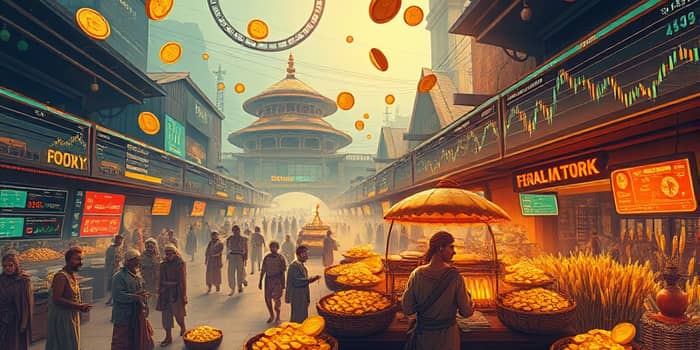
Throughout human history, the markets we navigate today are built upon the dreams and ingenuity of those who came before us. This narrative traces the remarkable journey from rudimentary barter systems to the sophisticated global capital markets that power our world.
Long before digital screens and ticker tapes, Sumerian farmers and herdsmen introduced the concept of futures by sealing clay bulla tokens to represent livestock and crops. These artifacts marked a revolutionary shift from direct barter to standardized, tokenized trading, allowing participants to agree on prices and delivery dates well in advance.
By embedding delivery instructions on tablets alongside bulla, these early traders effectively created the world’s first futures markets, mitigating the uncertainty of harvest yields and animal health. Their innovation laid the foundation for risk management techniques that still underpin modern finance.
As trade routes expanded in Europe, the Amsterdam Bourse emerged in the 1500s, offering sophisticated contracts including short sales, forward agreements, and options. Investors no longer needed to handle physical goods; they could speculate on price movements alone, unlocking diversification and inflation hedging benefits.
In the 1700s, Japan formalized its own exchange, while across the Atlantic, the Chicago Board of Trade (CBOT) opened its doors in 1848. By standardizing contract terms—defining quality, delivery time, and quantity—the CBOT streamlined transactions and democratized access for farmers and merchants alike.
Below is a concise overview of key developments that shaped global markets:
In 19th-century North America, grain elevators and rail networks revolutionized farming. Elevators acted as vital commercial hubs, allowing farmers to store grain until prices peaked. Communities banded together to build cooperative elevators, securing fairer terms and reducing exploitation by monopolistic shippers.
By converting grain into collateral, elevators enabled smallholders to access credit. This mechanism of capital formation underpinned rural development and set a precedent for asset-backed financing that resonates in today’s lending markets.
After World War II, the CBOT expanded its offerings with soybeans, cotton, and livestock. Meanwhile, precious metals joined COMEX in the 1960s, and by the 1970s, currencies and index futures transformed abstract values into tradable products. The shift from physical delivery to cash settlement ushered in a new era of financial innovation.
Advanced practitioners could now manage exposure to interest rates, exchange rates, and stock indices, applying techniques originally devised for grain to the world of bonds, equities, and beyond.
The 1970s oil crisis underscored the need for transparent pricing. The New York Mercantile Exchange launched West Texas Intermediate futures in 1983, quickly followed by Brent contracts. Crude oil became the world’s leading commodity, with derivatives markets providing critical tools to hedge geopolitical and supply risks.
Technological advances like shale extraction in the early 21st century further expanded production, demonstrating how innovation in one sector can ripple across the entire global economy.
With the advent of electronic trading and Internet connectivity, super-exchanges emerged, consolidating regional markets into global platforms. Traders from remote islands gained access to the same price feeds as those in New York or Tokyo, creating a truly interconnected marketplace.
The introduction of the Globex system by CME in 1992 exemplified this transformation, enabling 24-hour trading across multiple asset classes and time zones.
In 1991, the launch of the S&P GSCI opened commodity investing to ordinary investors. Commodities, once reserved for specialized traders, became accessible through indices and exchange-traded funds. This democratization provided low-cost, liquid vehicles for portfolio diversification and risk management.
The evolution from bulla tokens to electronic derivatives markets offers timeless insights:
As technology advances—incorporating blockchain, algorithmic trading, and artificial intelligence—the next chapter of market evolution is already unfolding. The core principles remain: innovation, risk management, and the human drive to exchange value. By learning from history, we can navigate uncertainty, seize opportunity, and contribute to a more resilient global economy.
References