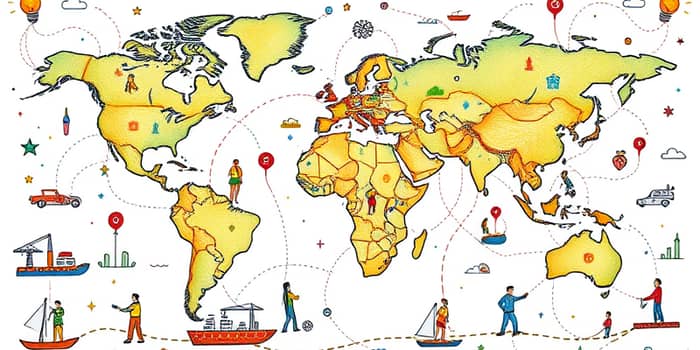
In an era where the boundaries between local economies and global networks blur, businesses, governments, and communities alike navigate a complex web of relationships. This interconnectedness has reached a record high of 25% on the Global Connectedness Index in 2025, demonstrating resilience in the face of political tensions and economic headwinds.
From the flow of goods valued at $35 trillion to digital services delivered across continents, the shape of commerce continues to evolve. Local suppliers find new opportunities, and communities experience both the benefits and challenges of being part of a larger, dynamic system.
The concept of interconnectedness extends beyond mere trade volume. It encompasses the movement of capital, information, and people, weaving together value chains that span multiple continents. Nearly two-thirds of global trade now occurs within these integrated networks.
Such integration allows firms to specialize and tap into the most efficient producers of inputs, while consumers enjoy access to a wider variety of goods and services. At the same time, it introduces complexities: supply disruptions in one region can reverberate internationally, and policy changes can influence partners thousands of miles away.
In 2025, global trade volume reached an unprecedented $35 trillion, marking a 7% increase over the previous year. This surge was driven in part by companies accelerating shipments ahead of anticipated tariffs, as well as rapid growth in sectors fueled by artificial intelligence.
Services trade also outpaced goods, growing 9% and accounting for 27% of overall trade flows. Digitally deliverable services now make up 56% of global services exports, illustrating how the digital economy reshapes traditional boundaries.
Several key drivers propel the ongoing integration of markets.
As these forces interact, they create a feedback loop: more connectivity begets further specialization, investment, and innovation, reinforcing the global tapestry of trade and services.
While traditional centers of globalization such as Europe and North America remain deeply connected, emerging regions are gaining ground. Singapore leads the world in overall global connectedness, followed by Luxembourg and the Netherlands. These economies benefit from strategic locations, open trade policies, and advanced infrastructure.
South-South trade flows have surged, with Africa and Latin America forging stronger ties. Developing markets now account for over half of Africa’s exports destination, and regional agreements like EU-India and Mercosur pacts aim to reduce trade barriers.
Mexico’s extensive network of free trade agreements positions it as a bridge between North and South America, while the Middle East and North Africa region ranks third globally for connectivity gains, thanks in part to lower tariff exposure and investment in logistics.
Despite the benefits of interconnected markets, several challenges and risks must be managed.
Balancing resilience against efficiency is a central dilemma. Diversifying supply sources reduces vulnerability to shocks but may introduce higher costs and complexity for businesses.
Forecasts for global economic growth in 2026 range from 2.6% to 3.3%, depending on the source. Technological investment, particularly in AI and digital infrastructure, could offset headwinds from slowing consumption and lingering policy uncertainties.
These projections underscore the importance of agility and adaptation. Countries and firms must invest in digital skills, upgrade logistics networks, and pursue policies that foster both trade and innovation.
Local firms and communities can take proactive steps to embed themselves in global value chains:
By aligning local strengths with global demands, businesses not only secure new markets but also contribute to resilient, diversified economies that can withstand future shocks.
The journey from local to global markets is both an opportunity and a challenge. The sustained high level of interconnectedness—reflected in the 56% of exports that are digitally deliverable and the intricate web of trade relationships—demonstrates that integration remains a defining feature of the modern economy.
To navigate this landscape, stakeholders must balance open trade with strategic resilience, invest in digital and physical infrastructure, and cultivate skills that match the evolving demands of global value chains. In doing so, they will ensure that local communities not only connect with but also thrive within the global marketplace.
Ultimately, the tapestry of interconnected markets offers a path to greater prosperity, innovation, and shared global progress—if we embrace collaboration, inclusivity, and forward-looking strategies.
References