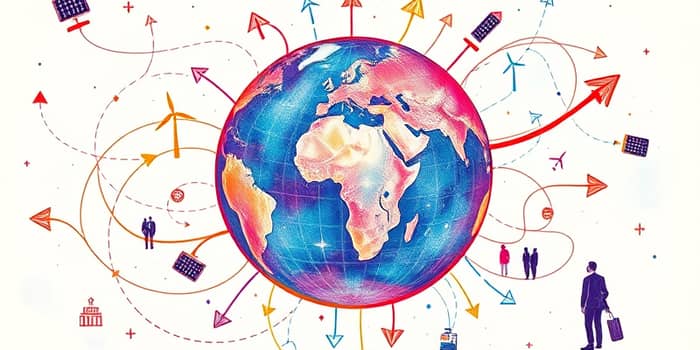
The world economy stands at a crossroads, buffeted by rising geopolitical tensions, rapid technological change, and an urgent climate imperative. Policymakers, businesses, and individuals must adapt to this era of unprecedented uncertainty by embracing resilience, innovation, and cooperation.
As growth forecasts diverge and trade barriers climb, nations and corporations are reshaping strategies to survive and thrive. This article explores major trends, their implications, and offers practical guidance to navigate the global economic reshuffle.
Global growth projections for 2025 and beyond vary significantly. The International Monetary Fund raised its forecasts to 3.0% in 2025 and 3.1% in 2026, reflecting optimism in recovery momentum. In contrast, the United Nations Conference on Trade and Development warns of a slowdown to 2.3% in 2025—below the 2.5% recession threshold.
Amid this split, the Economic Policy Uncertainty Index hit record highs in early 2025, underscoring the volatility policymakers face. S&P Global’s upgraded forecasts for the US (+0.2%), the eurozone (+0.3%), and China underline pockets of strength, while McKinsey Intelligence warns of 4.2% inflation in 2025 and persistent downside risks from rising tariffs.
This divergence mandates flexible strategies. Businesses must plan for both expansion and contraction scenarios, while investors should diversify portfolios across regions and asset classes.
Since January 2025, the US has enacted its most sweeping tariff regime since the 1930s. A baseline 10% duty on most imports, 50% on copper, and 25% on cars propelled the effective tariff rate to 18.2% by mid-2025. Such measures have triggered global economic fragmentation and accelerated supply-chain realignment.
In response, China has redirected exports toward Europe (6% growth) and North America’s neighbors (25% growth). Meanwhile, South–South trade, now one-third of global commerce, is outpacing other flows, driven by intra-regional markets in East and Southeast Asia.
For firms, proactive engagement with new trade blocs and digital trade platforms can unlock alternative markets and reduce costs. Governments must support market access negotiations and regional infrastructure projects to maintain competitiveness.
The 2025 Global Risks Report paints a grim picture: 52% of risk officers foresee an “unsettled” near term, with conflict, misinformation, and severe weather at the fore. Geopolitical fractures threaten cross-border cooperation on finance, climate, and security.
Businesses and investors should incorporate scenario planning for geopolitical shocks, including sanction regimes, supply disruptions, and cyber threats. Developing a comprehensive risk management framework is now indispensable.
Official development assistance fell by 18% between 2023 and 2025, exacerbating capital shortages in low-income countries. Over half of these nations face high debt distress, squeezed by tight financing and rising borrowing costs. As funds flow toward perceived safe havens, developing economies are caught in a perfect storm.
To alleviate this, multilateral institutions and donor governments must coordinate debt rescheduling, boost concessional financing, and channel investments into critical sectors such as healthcare, education, and green infrastructure.
AI and data analytics are revolutionizing work. Eighty-six percent of employers expect AI to reshape their sectors, creating 170 million new roles by 2030 while automating 92 million existing jobs. Tech firms have slashed thousands of positions in 2025, partly to fund AI ventures.
New roles—AI engineers, prompt specialists, data scientists—are emerging, but many entry-level positions may vanish. To navigate this shift, workers and educators must prioritize lifelong learning and digital skills development. Employers should collaborate with training institutions to upskill employees.
Data shows women disproportionately face job displacement by GenAI (57% vs. 43%), while men benefit more from augmentation. Targeted initiatives are needed to ensure equitable access to AI-driven opportunities.
In 2025, renewable energy reached a tipping point: solar costs 41% below fossil fuels and wind 53%. Renewables accounted for 92.5% of new capacity additions in 2024, yet most investment concentrated in advanced economies and China.
China’s clean energy surge—matching first-quarter 2025 solar output to all of 2020—illustrates the scale of transformation. However, global data center power needs are projected to grow from 1% of electricity demand in 2022 to over 3% by 2030, threatening to outpace clean deployments.
Policymakers should accelerate policy frameworks for grid modernization, incentivize storage solutions, and implement carbon pricing. Businesses can commit to science-based targets and invest in energy efficiency to mitigate both costs and emissions.
By 2080, seniors aged 65 and above will outnumber those under 18, ushering in a longevity economy. Adapting to longer lives requires pension reform, lifelong learning platforms, and expansion of caregiving industries.
Key actions include:
To harness the potential of longevity, businesses can design products and services for older demographics, while governments ensure inclusive social safety nets.
The global order is shifting toward multipolarity, with competing centers of economic and technological power. Countries must balance strategic partnerships with self-reliance, investing in secure supply chains, critical infrastructure, and digital sovereignty.
For individuals and organizations, adaptability is paramount. Embrace agility in planning, cultivate cross-cultural competencies, and monitor policy developments across major blocs.
The current economic reshuffle offers both risks and opportunities. By acknowledging deep uncertainties and adopting proactive strategies, we can turn challenges into drivers of innovation, resilience, and inclusive growth.
Practical steps include:
Ultimately, collaboration—across borders, sectors, and generations—will determine our collective success. In this pivotal moment, let us harness the power of cooperation, creativity, and courage to build a more equitable and prosperous global economy.
References