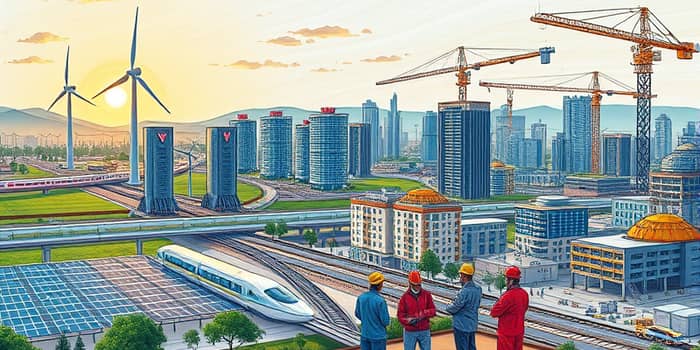
Across the globe, aging highways, overburdened power grids, and scarce digital capacity are impeding economic growth and sustainability. The scale of the challenge is immense: industry analysts estimate that more than $106 trillion in cumulative investment will be required by 2040 to overhaul transport, energy, water, and digital networks. Yet within this vast need lies an unprecedented opportunity to ignite economic revival and shape a more resilient, efficient future.
By embracing technological innovation, clean energy transitions, and strategic onshoring, governments and businesses can transform infrastructure into a catalyst for prosperity. This article explores the megatrends driving investment, the critical role of AI and data centers, and practical steps stakeholders can take today to ensure tomorrow’s systems are sustainable, flexible, and inclusive.
Global infrastructure spending must accelerate dramatically. Transport and logistics demand alone accounts for nearly a third of the total, while energy, digital, social services, water, agriculture, and defense also require massive capital infusions. Private investors have recognized the potential: assets under management in infrastructure soared from $500 billion in 2016 to $1.5 trillion in 2024, illustrating strong confidence in long-term returns.
Effective allocation of resources requires clarity on sector priorities. The table below highlights the projected investment breakdown by major categories:
Investment strategies today center on the “Three D’s” framework—Digitalization, Decarbonization, and Deglobalization—each presenting unique challenges and openings for innovation.
Artificial intelligence is reshaping infrastructure requirements. Analysts forecast that global AI workloads will boost data center demand by over 50% by 2030, while current facilities already consume around 4% of U.S. electricity. As AI applications multiply, power consumption may quadruple within two decades, intensifying grid stress.
Moreover, data center vacancy rates have plummeted to historic lows, squeezing capacity and driving up pricing. Average lease rates for medium-scale deployments rose 13% year-over-year, reflecting fierce competition for contiguous space. Utilities, once dominant in capital expenditures, are now rivaled by hyperscale operators who channel record sums into cloud and edge computing facilities.
Decarbonization efforts are gaining momentum as wind and solar capacity expand roughly 20% annually. Electric vehicle fleets and heat pump installations are climbing, reflecting growing demand for cleaner energy solutions. Yet interconnection queues remain clogged: nearly 95% of pending projects involve renewables or storage, requiring innovative regulatory reforms to accelerate grid access.
Industry experts note that if AI data centers agreed to curtail just 1% of their load, grid operators could integrate an additional 126 GW of generation without major upgrades. Flexibility in demand-side management will be crucial as executives increasingly view load adaptability as key to securing rapid market entry.
To meet rising demand for net-zero structures, 75% of construction firms are dedicating resources to decarbonization initiatives. Adoption of sustainable materials—engineered timber, low-carbon concrete, bio-based insulation—and modular construction methods promises faster build times, lower costs, and reduced waste.
Emerging technologies such as 3D printing enable the creation of complex structural components on-site, while smart sensors and data analytics drive efficiency in design and maintenance. As these capabilities mature, the sector is poised for 6–7% annual growth through 2030, fueled by public and private funding across Asia, Europe, and North America.
Digital connectivity and smart mobility are transforming cities and supply chains. Rapid 5G rollout in India and the Middle East, coupled with fiber upgrades in Africa, is unlocking new opportunities for remote monitoring, asset tracking, and automated logistics.
AI-driven optimization in transportation has delivered up to 15% reductions in labor costs and 20–30% lower maintenance expenses through predictive analytics. Real-time infrastructure health platforms now flag anomalies before failures occur, enhancing safety and reliability for mass transit and utility networks alike.
To capitalize on these trends, stakeholders must adopt a holistic, collaborative approach. Key steps include:
By embracing innovation and sustainability as guiding principles, decision-makers can transform the infrastructure landscape. The path forward demands both ambition and pragmatism: aligning regulatory frameworks, cultivating new skill sets, and mobilizing capital at scale.
As the world grapples with climate change, rapid urbanization, and technological disruption, a revitalized infrastructure platform offers hope for inclusive growth and resilience. The investments made today will shape societies for decades to come, driving prosperity, safeguarding resources, and empowering communities everywhere.
Now is the moment to build smarter, greener, and more connected systems—ensuring that modernization efforts not only meet immediate needs but also pave the way for a sustainable, efficient, and equitable future.
References