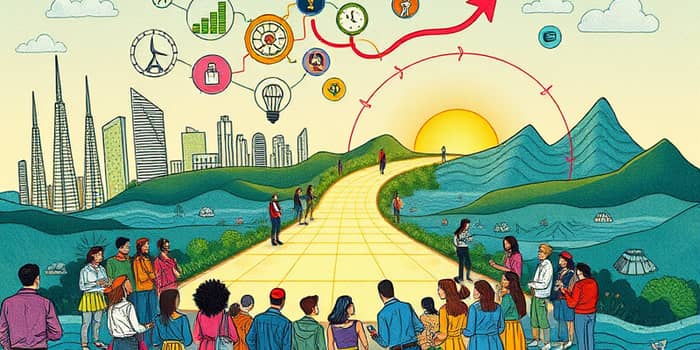
Innovation pathways offer a strategic blueprint for nations and organizations to convert bold ideas into real-world impact. By mapping phases, milestones, partnerships, and feedback loops, these frameworks guide stakeholders through each stage of development. In an era defined by rapid technological change and rising socio-economic challenges, such structured approaches are critical to achieving scalable outcomes.
The concept of innovation pathways centers on structured roadmaps outlining phases and milestones that streamline progress. These pathways align with nexus goals—sustainability, risk intelligence, and just transitions—to foster transform ideas into scalable solutions.
At their core, innovation pathways counteract five fragmentation forces: disruption, disconnection, disparity, destruction, and discontent. They do so by leveraging five integration forces: resilience, exponential growth, expanded access, circular economies, and wellbeing, thereby creating multi-capital value across six dimensions.
By harnessing integration forces, stakeholders can unlock resilience, exponential expansion, circular and wellbeing economies. These include financial, infrastructural, technological, human, social, and ecological capital. When aligned, such streams produce compounding benefits that ripple through industries and communities.
As we look to 2026, global GDP growth forecasts underscore the importance of innovation-led strategies. Projections vary slightly, reflecting diverse drivers such as technology investment, policy shifts, and market resilience.
Emerging markets such as India and China are poised to outpace advanced economies, driven by accelerated tech adoption and human capital development.
Historical analyses reveal that well-orchestrated pathways contributed an estimated $1.36 trillion to global output during previous industrial waves. This underscores the potential of cohesive strategies in shaping economic trajectories.
Moreover, nearly half of developing countries now embed STI strategies within national plans, reflecting a shift from resource-led to knowledge-based growth models.
Across the globe, diverse economies demonstrate the power of well-designed pathways. In Kenya, catalytic STI interventions have accelerated agricultural value chains and mobile financial services. Malaysia’s innovation clusters attract research talent and drive export diversification. In India’s Gujarat region, public–private partnerships foster R&D diffusion and strengthen human capital.
Another powerful illustration is the network model pioneered in Europe, where inventors, transformers, financiers, and brokers form a web of collaborations. This multi-actor design enhances adaptability and knowledge diffusion.
In South Asia, circular economy pilots in textile manufacturing demonstrate how waste streams can become input for new products, generating jobs and reducing environmental harm. At the micro level, specific career pathways connect educational curricula with industry needs, equipping individuals with skills aligned to emerging sectors and catalyzing local innovation hubs.
Successful implementation requires continuous feedback loops and performance metrics. Data-driven dashboards and periodic reviews help refine milestones and ensure accountability.
Public–private collaboration remains indispensable. Governments can convene stakeholders, but agility often comes from entrepreneurial ventures and civil society coalitions that iterate solutions rapidly.
Embracing the Fourth Industrial Revolution means melding digital, physical, and biological domains to foster exponential value creation. Policymakers should invest in advanced manufacturing, biotech, and IoT to stay ahead of the curve.
Innovation pathways are more than frameworks; they are dynamic journeys that evolve with stakeholder input and global trends. By integrating resilience and circular principles, economies can weather shocks and pivot swiftly.
Looking forward, the nexus paradigm—combining socio-environmental adaptation with risk intelligence—will be vital. Policymakers and leaders must embrace exponential technologies while safeguarding equity and ecological integrity.
Ultimately, the true measure of success lies in inclusive prosperity. Through global alliances driving regional scaling and sustained partnerships, innovation pathways can unlock unprecedented value and shape a thriving future for all.
As innovation pathways evolve, they will redefine what is possible, building economies that are adaptive, inclusive, and poised for the challenges of tomorrow.
References