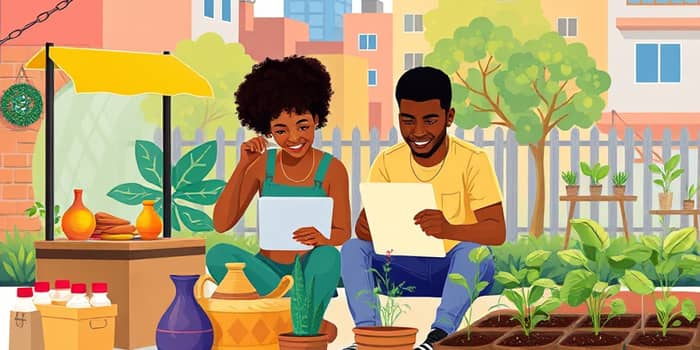
Micro-entrepreneurship breathes life into communities by creating jobs, fostering resilience, and channeling local ingenuity into sustainable growth. These small-scale ventures, often informal and capital-light, form the backbone of economies everywhere.
At its core, micro-entrepreneurship involves individuals or small teams launching ventures with minimal capital, typically employing fewer than ten people. These businesses thrive on low barriers to entry, prioritizing skills and adaptability over large infrastructure investments.
Unlike high-growth startups, micros emphasize stability over scaling, offering a flexible path to self-employment and community support. Across digital platforms and local markets, they harness creativity and resourcefulness to meet everyday needs.
Microbusinesses comprise over 90% of enterprises worldwide and generate more than half of all jobs. In advanced economies, they account for roughly 66% of business-sector employment, climbing to 77% in emerging markets.
These figures illustrate the sheer scale of micro-entrepreneurship’s footprint: from bustling markets in Lagos to digital workshops in Bangalore, small ventures drive economic activity and social cohesion.
Micro-entrepreneurs ignite a virtuous cycle of prosperity by creating jobs, reducing unemployment, and increasing incomes. In the U.S., small businesses generate two-thirds of new positions—about 17 million net jobs since 1995.
Beyond numbers, these ventures foster social inclusion, enabling women, youth, and underserved demographics to participate in value creation and gain financial independence.
In sub-Saharan Africa, necessity often sparks enterprise. Informal microbusinesses—street vendors, tailors, and artisans—support over 80% of the workforce, contributing half of the continent’s GDP.
In Miami-Dade County, a surge in micro-entrepreneurs during economic downturns helped blunt unemployment spikes, showcasing the catalyst for local prosperity that small ventures represent.
Meanwhile in Latin America, rapid tech adoption is reshaping micros into digital storefronts. From artisanal marketplaces in Mexico City to e-commerce hubs in São Paulo, micro-entrepreneurs leverage platforms to reach global customers.
Evidence shows targeted support can dramatically enhance outcomes. Short-term training and small grants lift self-employment rates by 15–25%, while larger seed capital often sustains long-term independent ventures.
During the COVID-19 pandemic, micro-entrepreneurship programs served as a backstop for millions, preventing deeper recessions and preserving livelihoods through emergency grants and digital upskilling.
Despite their impact, microbusinesses face hurdles: informality limits access to finance, high compliance costs deter growth, and many remain invisible to policymakers.
Yet the digital revolution offers unprecedented opportunities. From cloud-based accounting to social media marketing, emerging tools empower micros to streamline operations, reach new markets, and scale sustainably.
The rise of the creator economy further expands horizons. Independent designers, tutors, and content producers now monetize skills online, blending creativity with entrepreneurship in a new wave of microventures.
By 2026, estimates suggest digital integration and localizing demand could generate 10–16 million new U.S. jobs from microbusinesses alone. In emerging markets, mobile finance and peer-to-peer lending promise to narrow the financing gap.
To unlock this potential, stakeholders must focus on inclusive policies: simplifying registration, expanding microcredit, and fostering digital literacy. Local governments, NGOs, and private partners can co-create ecosystems where small ventures thrive.
In every corner of the globe, micro-entrepreneurs stand at the intersection of innovation and necessity. Their resilience and ingenuity chart a path toward more balanced and inclusive growth.
Empowering these small-scale pioneers is not just an economic strategy—it’s a commitment to community, creativity, and shared prosperity. By nurturing micro-entrepreneurship, we sow the seeds of sustainable development and unlock the potential of countless individuals ready to shape tomorrow’s local economies.
References