The widening gap between the world’s richest and poorest regions shapes futures, fosters unrest, and challenges our collective conscience. This article travels through continents, revealing stark contrasts in income and wealth, exploring systemic drivers of inequality, and imagining pathways toward greater fairness. By shining light on the contrasting daily realities of families, workers, students, and entrepreneurs, we uncover how geography dictates opportunity. Our goal is not only to inform but to inspire action, fostering a new era of global solidarity.
Around the globe, economic gains are distributed unevenly. Today, the top 10% of global adults receive more than half of total income, while the bottom half captures a minute fraction. Wealth concentration is even more pronounced, as the top decile controls roughly three quarters of global assets. Such extremes raise urgent questions: What systemic barriers sustain this imbalance? How can policy interventions and grassroots movements tilt the scales toward inclusion?
By examining metrics like the share of income, the ratio of wealth holdings, and the evolution of inequality over decades, we gain critical insight. These figures are not abstract: they represent families striving to secure education, healthcare, and dignified livelihoods. Understanding the global panorama of privilege and deprivation is the first step in addressing the entrenched geography of opportunity.
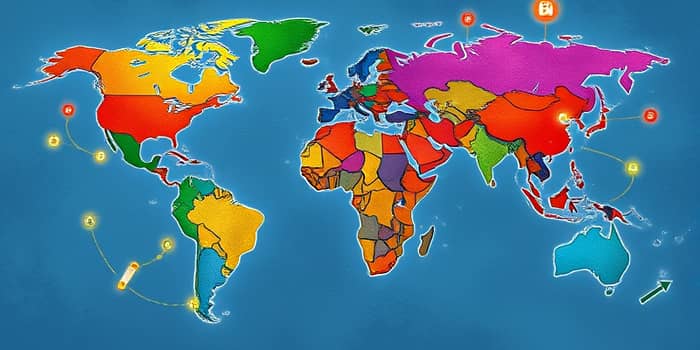
Income levels vary dramatically across regions. Residents of North America and Oceania enjoy average daily earnings that tower over those in Sub-Saharan Africa by more than a factor of thirteen. Europe also ranks among the high-income tier, while regions such as Latin America and South Asia occupy the middle and lower echelons. These differences shape life choices, from nutrition and healthcare to education and housing security.
Such disparities are not simply the product of geography, but the outcome of historical trade patterns, governance structures, and investment flows. While some regions harness innovation and infrastructure to drive prosperity, others grapple with underinvestment and volatile commodity markets. Recognizing these patterns is key to designing targeted interventions that can uplift communities and redistribute economic power.
Wealth, distinct from income, captures accumulated assets—real estate, savings, business holdings, and investments. Here, gaps widen further: the average adult in North America & Oceania holds more than sixteen times the wealth of a counterpart in Sub-Saharan Africa. Europe and East Asia also exhibit strong wealth accumulation, while South Asia and Latin America lag despite growth in income.
These imbalances reflect both historical legacies and contemporary capital flows. Wealth provides security against shocks and the freedom to pursue opportunities, yet when concentrated in the hands of a few, it undermines social cohesion and stifles inclusive growth. Charting a course toward equity demands transparent financial systems, progressive taxation, and support for small entrepreneurs.
Education spending per child varies more than fortyfold between regions. In North America & Oceania, governments invest roughly €9,000 per student, while Sub-Saharan Africa often must manage with only about €200. This staggering resource gap of opportunity entrenches cycles of poverty by limiting skill development and reducing employability in the global market.
Bridging this divide requires not only increased funding but also community involvement, curriculum reform, and innovative delivery methods. Expanding digital access, training teachers, and nurturing critical thinking can transform lives. When every child gains a solid foundation, societies flourish, unlocking human capital that powers sustained economic resilience and social progress.
Even within regions, women face disproportionate barriers. Globally, women earn just 61% of what men receive per working hour, a figure that drops to 32% when unpaid labor is included. This deeply rooted gender pay gap reflects cultural norms, occupational segregation, and inadequate legal protections. As a result, half the world’s talent remains undervalued and underutilized.
Efforts to close this gap involve legal reforms, corporate accountability, and social awareness campaigns. Inclusive parental leave policies, transparent pay scales, and investments in caregiving infrastructure can boost women’s participation in the formal economy. Empowering women unleashes a multiplier effect, as households reinvest earnings in health, education, and community well-being.
Global economic growth is projected at 2.7% in 2026, slightly below pre-pandemic rates. Yet beneath the surface, fortunes diverge. Some regions accelerate, while others stall under debt burdens, climate shocks, or geopolitical tensions. Understanding these trajectories is crucial for crafting policies that foster resilience rather than exacerbate divides.
Alongside numbers, narratives matter. Emphasizing slowing global economic momentum without context can breed complacency. Instead, leaders must deploy tailored investments, strengthen regional cooperation, and support local entrepreneurs. By focusing on inclusive growth, economies can generate widespread benefits.
Addressing regional disparities demands a multi-layered strategy. National governments can implement progressive taxation, boost public services, and invest in green infrastructure. International institutions should recalibrate financial flows, reduce debt burdens, and foster knowledge sharing. Meanwhile, civil society and private sectors play vital roles in job creation and skills training.
A shared vision of shared prosperity and mutual growth transcends borders. By promoting fair trade, championing community development projects, and embracing technological innovation, we can unlock the potential of every region. The path to a more equitable world lies in collaboration, empathy, and unwavering commitment to justice.
The journey is neither quick nor simple, but as history shows, transformative change begins with awareness, builds through action, and endures when communities unite behind a common purpose. Let us heed the call to build bridges over the great divide, ensuring that opportunity flows freely to every corner of the planet.
References