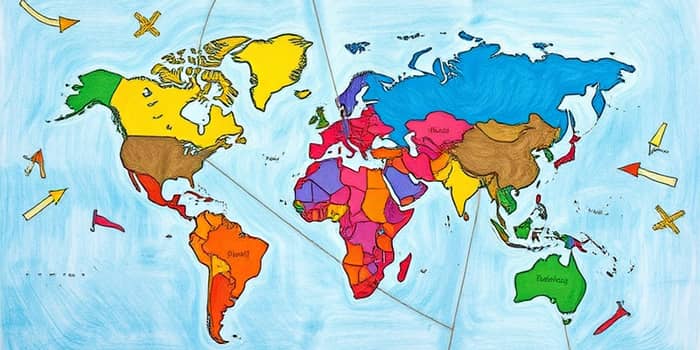
Economic inequality has become a defining backdrop of our era, shaping the lives of billions. By focusing on regional disparities, we uncover the forces that drive wealth and opportunity gaps, and explore pathways toward a more equitable future.
Across the world, economic outcomes are heavily polarized. While the global economy has expanded over recent decades, the distribution of gains remains skewed toward those at the top of the income ladder.
The divergence between wealth and income is pronounced: in North America & Oceania, the average adult holds nearly three hundred percent above average wealth, whereas in Sub-Saharan Africa that figure drops to around twenty percent.
While some regions flourish, others struggle under the weight of historical and structural challenges. To grasp the magnitude of these disparities, consider the following comparative ratios:
Within each region, internal divides compound the challenge. In North America & Oceania, rising average wealth masks the fact that the top 1% hold more assets than the bottom 90% combined. Meanwhile, Sub-Saharan Africa confronts both low average levels and extreme inequality.
Global output is expected to grow by 2.7% in 2026, trailing the pre-pandemic average of 3.2%. Yet this growth will not be evenly shared:
Regions beset by debt burdens or geopolitical tensions may see their progress stalled, emphasizing the urgent need for global coordination to ensure no region is left behind.
Unequal access to education and skills training fuels tomorrow’s income gaps today. In Sub-Saharan Africa, spending per child averages €200 (PPP), compared to over €9,000 in North America & Oceania. This disparity represents a gulf in formative opportunities.
Addressing this requires broadening access to quality education and designing interventions that reach the most marginalized students, thereby nurturing human capital that benefits societies at large.
Financial flows can deepen divides when net income transfers shift roughly 1% of global GDP from poor to rich countries each year. These yield imbalances far exceed the scale of official development aid.
Reforming international financial architecture to promote fair returns on investment and debt servicing is essential for reversing entrenched imbalances.
Women’s economic contributions remain undervalued everywhere. Excluding unpaid work, women earn just 61% of what men earn per working hour; including unpaid labor, this falls to 32%. Globally, women shoulder a heavier burden of unpaid care work, reinforcing persistent structural inequalities profoundly shape outcomes.
Equalizing labor market opportunities and valuing unpaid labor are critical steps toward closing this gap.
Global investment growth has slowed amid fiscal constraints and geopolitical tensions. Meanwhile, advances in artificial intelligence have sparked concentrated capital spending in a few markets, with benefits yet to reach most developing economies.
Without deliberate policies, AI could exacerbate divides. There is an urgent need for global coordination to foster ensuring equitable technological benefits globally, from digital infrastructure to skills training in emerging regions.
Headline inflation is projected to ease from 3.4% in 2025 to 3.1% in 2026, yet uneven supply bottlenecks, climate-related shocks, and geopolitical risks will sustain price pressures. Low-income households bear the brunt of high food, energy, and housing costs.
Targeted social safety nets and food security programs can shield vulnerable populations and prevent further widening of economic gaps.
Inequality’s roots run deep in colonial legacies, institutional dynamics, and power imbalances. Over centuries, some regions have benefited from favorable trade, resource endowments, and political stability, while others have been marginalized.
Understanding these historical patterns is vital for crafting policies that repair long-standing damages and foster targeted investments in emerging markets that can unlock new growth paths.
Bridging the global economic chasm demands collaborative action across stakeholders. By aligning policy, finance, and technology, we can catalyze inclusive growth.
Only through comprehensive policy interventions guided by solidarity can we transform the great divide into a pathway toward shared prosperity and sustainable development.
References