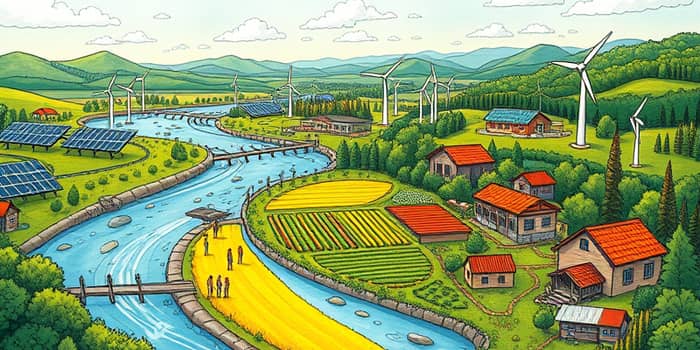
Throughout history, societies have wrestled with the specter of scarcity. Today, traditional boundaries are shifting as we embrace adaptive, technology-driven and integrated strategies to reimagine our relationship with essential resources. This evolution offers hope for a more resilient and equitable future.
Nearly two-thirds of the global population endures acute water shortages for at least one month each year, a stark reminder that water remains our most volatile resource. As climate change intensifies droughts and heatwaves, millions face displacement and economic hardship. By 2025, half of humanity may live in water-scarce regions, while 4 billion people experience severe scarcity annually.
Water scarcity drives forced migration, with 700 million people projected to be displaced by 2030. By 2040, one in four children will live in regions suffering severe shortages, jeopardizing health, education, and future prospects. Over-extraction lowers water tables, causing land subsidence across 6 million square kilometers, roughly twice the size of India. Annual costs of drought exceed US$307 billion, and by 2050, climate risks could cost S&P Global 1200 companies US$1.2 trillion per year, with water stress accounting for US$265 billion.
Beyond water, interconnected resource planning and management is critical as pressures mount on land, food systems, energy, minerals, and biodiversity. Every drought or flood triggers ripples across supply chains, ecosystems, and livelihoods, demanding a holistic response.
Our planet’s resources are deeply entwined:
Salinization accumulates salts in soils, diminishing yields and driving farmers off their land. Energy transitions highlight tough trade-offs: renewable power cuts emissions but often requires significant water for cooling and manufacturing. Mineral extraction in Africa and Latin America meets cobalt and lithium demands but raises concerns over labor conditions, contamination, and geopolitical dependencies.
Food systems remain deeply water-dependent, with agriculture accounting for 70% of global freshwater withdrawals. Droughts and floods, intensified by shifting climate patterns, erode productivity. The economic toll of natural disasters surged to US$320 billion in 2024, underscoring the vulnerability of our globalized supply chains.
Biodiversity loss exceeds safe boundaries, with extinction rates far above natural baselines. Forests once covering 30% of land are shrinking, undermining carbon sinks and destabilizing weather patterns. Achieving protected area targets for 30% of land and marine realms by 2030 remains chronically underfunded, leaving countless ecosystems exposed.
To navigate this “new era,” we must pursue objectives balancing ecology, economy, and equity:
Integrated management weaves together water, land, and energy planning under a holistic and data-driven approach. Efficiency gains arise from circular economy principles—reusing, recycling, and remanufacturing to extend resource life. Renewable technologies, from solar and wind to smart irrigation, promise significant savings, while land-specific methods like agroforestry, terracing, and rainwater harvesting bolster soil health, reduce erosion, and store carbon.
Effective SRM relies on robust monitoring frameworks. Indicators tracking consumption, efficiency, and ecosystem health enable decision-makers to revise plans as conditions change. By adopting strategies that are optimal for variable growth scenarios, communities can adapt to booms or downturns without costly overhauls.
Understanding national contexts helps tailor solutions. The following table highlights country categories based on projected water scarcity in 2026:
India’s example illustrates geopolitical and environmental risks. Home to 18% of the population but only 4% of freshwater, India faces a 60% reduction in Brahmaputra flows due to upstream projects. This underscores the need for cross-border cooperation and resilient planning.
Emerging trends in 2026 spotlight the intersection of technology, policy, and resilience. Decision-makers increasingly embrace learning-by-doing and adaptive management to navigate uncertainties. Real-time sensors, AI-driven analytics, and IoT networks optimize water distribution and crop yields, reducing waste and enhancing responses to extreme events.
One-third of global executives now identify geoeconomic tensions as a top risk, even as resource shortages slip from the list. Critical minerals—copper, lithium, and rare earths—drive new trade and diplomacy, with China leading cleantech manufacturing. Diversification efforts in Europe and North America aim to strengthen resilient supply chains and transparent agreements.
Emerging as a key trend in 2026, the blue economy harnesses ocean resources while prioritizing blue economy and water resilience. Coastal aquaculture, marine protected areas, and advanced desalination technologies expand opportunities for sustainable growth, offering a lifeline to communities facing coastal scarcity.
Rethinking scarcity is more than a conceptual shift—it demands coordinated action at every level, from local farms to global alliances. Each of us plays a role: communities innovating in resource-poor regions, businesses investing in sustainable supply chains, and governments enacting forward-looking policies.
By embracing circular economy and waste reduction practices alongside visionary leadership, we can transform scarcity into abundance. The journey ahead will be challenging, but the rewards—a stable climate, thriving ecosystems, and shared prosperity—are within reach.
Let us step boldly into this era of integrated, resilient resource management, forging solutions that honor both people and planet. Together, we can build a future where scarcity is not a destiny but an opportunity for renewal.
References