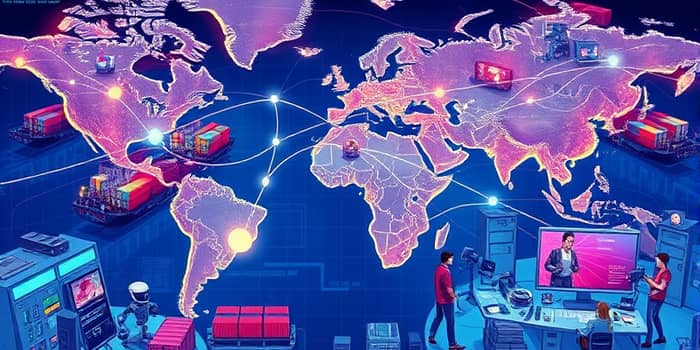
In an era marked by rapid technological change and geopolitical uncertainty, supply chains have emerged as the backbone of global commerce. Organizations must evolve beyond simple disruption responses and embrace a holistic vision that balances resilience, efficiency, and value creation. This journey demands innovation in every function, from procurement to distribution, and a willingness to reimagine traditional operating models.
Historically, supply chain strategies prioritized recovery after shocks, yet today’s market demands a proactive stance. Leading companies are now adopting Total Value as organizing principle to unify customer focus, financial health, and operational agility. By fusing risk management with performance metrics, this paradigm ensures that every decision drives both stability and growth.
At its core, this approach rests on three pillars: anticipating disruptions through accurate forecasting, leveraging data-driven insights and seamless integration across functions, and empowering teams with the right tools and authority. When organizations view supply chains as dynamic value engines, they unlock new opportunities to delight customers, streamline costs, and support sustainability goals simultaneously.
Tariffs and trade barriers have become fluid, introducing abrupt cost swings that can erode margins overnight. Recent shifts, such as tariffing based on Country of Diffusion rather than Country of Origin, have deepened this complexity. Meanwhile, the USMCA review and regional trade deals continue to reshape global sourcing economics.
To navigate these headwinds, companies are diversifying supply bases and modifying shipping routes to mitigate concentration risks. They are also stress-testing scenarios to model alternative flows in real time, ensuring they can pivot when policies shift or tensions escalate.
Advanced technologies now underpin every facet of modern supply chains. From AI embedded in platforms like Source-to-Pay to generative AI creating digital twins for scenario planning, the pace of innovation is accelerating. Companies investing heavily in artificial intelligence report significantly higher revenue growth and greater forecast accuracy.
Robotics and automation are transforming warehouses into intelligent hubs, where autonomous mobile robots and software orchestration work in concert. Meanwhile, real-time visibility platforms provide live insights into inventory levels, shipments, and supplier health. These capabilities shift decision-making from reactive firefighting to proactive optimization.
Amid renewed focus on supply chain resilience, nearshoring has surged as a strategic response. Mexico, for example, has strengthened its role as a gateway to the US market, offering quicker transit times and lower geopolitical risk. Simultaneously, US-plus-one strategies deploy secondary sourcing in Asia or Latin America to hedge against regional disruptions.
When assessing regional footprints, companies now calculate total landed costs, factoring in tariffs, labor rates, and carbon footprints. This comprehensive view guides investments in new facilities, transportation corridors, and inventory positions.
Despite surge in automation, human talent remains critical for strategic decision-making and exception management. Organizations are investing in training staff in data analytics and risk management to ensure teams can interpret complex signals and take decisive action. At the same time, workflow automation liberates employees from mundane tasks, allowing them to focus on innovation and continuous improvement.
Leadership development is also a top priority. With many senior executives nearing retirement, companies are creating rotational programs and mentorship initiatives to cultivate the next generation of supply chain leaders. This blend of digital tools and people-centered programs fosters an agile culture prepared for tomorrow’s challenges.
To translate vision into reality, supply chain leaders must prioritize investments and actions with clear ROI. Locking in longer-term contracts on critical routes secures capacity, while SKU-level transit analysis optimizes modal mixes between air, ocean, and parcel services. Consolidation strategies, such as daily groupage shipments, further reduce costs and carbon impact.
Cross-functional alignment remains essential. When commercial, logistics, finance, and procurement teams share performance metrics, they can jointly identify tradeoffs and innovate solutions that drive end-to-end efficiency. Likewise, partnering with technology providers who deliver robust near real-time insights ensures that data becomes a catalyst rather than a bottleneck.
Ultimately, the path to supply chain excellence in 2026 centers on balancing risk and opportunity, harnessing technology, and empowering people. By adopting a holistic, value-driven supply chain mindset, organizations can transform complex global networks into sources of competitive advantage, resilience, and sustained growth.
References