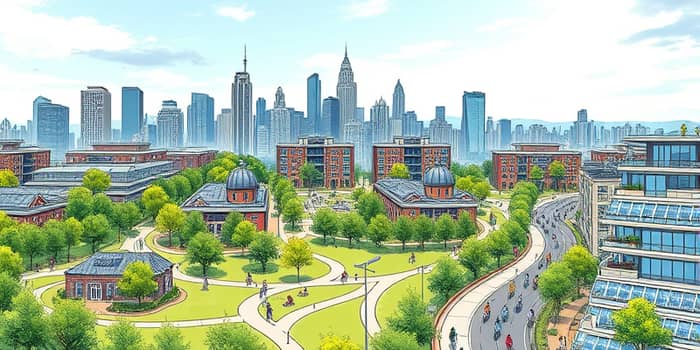
As urban populations surge, the challenge facing planners and communities is clear: foster growth without sacrificing our planet or social fabric. Sustainable cities combine economic prosperity with long-term resilience, integrating nature and innovation to create vibrant, adaptable environments for all.
At the core of sustainable design lies the principle of efficient land use and urban planning. By promoting compact, mixed-use development, cities can reduce commute times, lower greenhouse gas emissions, and nurture walkable neighborhoods.
Key elements include greening public spaces and preserving natural corridors. Parks, community gardens, and street trees not only beautify but also soften stormwater surges, mitigate heat islands, and encourage healthy lifestyles.
Successful sustainable cities embrace a suite of intertwined strategies that address environmental, social, and economic objectives simultaneously.
Real-world examples illuminate how these concepts translate into measurable gains.
Beyond environmental stewardship, sustainable infrastructure delivers tangible financial returns for cities, businesses, and residents.
Climate adaptation is a cornerstone of sustainable design. Nature-based solutions serve as living infrastructure.
Green corridors and wetlands absorb floodwaters, while urban forests cool neighborhoods by several degrees through shading and evapotranspiration.
Implementing a sustainable vision can encounter hurdles: funding constraints, regulatory obstacles, and community skepticism.
Strategies to surmount these barriers include:
Monitoring frameworks with clear metrics—such as green building coverage, water reuse rates, and equitable access scores—ensure accountability and continual improvement.
Sustainable urban design is neither a luxury nor an afterthought—it is an imperative. By weaving nature into the urban fabric, we create cities that are thriving economic engines and fortified against climate upheaval.
From the skyline gardens of Singapore to the bike-friendly streets of Copenhagen, and the transformational stormwater projects in Philadelphia, these examples underscore the power of collaboration across government, business, and community.
As cities worldwide confront rapid urbanization and mounting environmental risks, the blueprint for success lies in integrated strategies that deliver prosperity, health, and resilience for generations to come.
References