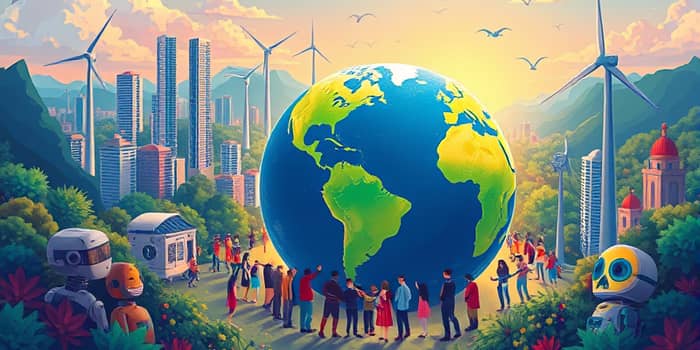
In an era defined by uncertainty and rapid change, the imperative to build a global economy that balances prosperity with preservation has never been clearer. From shifting trade patterns to the looming threat of climate disruption, leaders and citizens alike seek pathways toward lasting growth. This article lays out a comprehensive roadmap—melding economic performance, social equity, and environmental stewardship—to inspire collective action and drive real-world impact.
While recent data reflects unexpected resilience in output, underlying vulnerabilities threaten to stall progress. Charting a new course requires fresh thinking, bold policies, and cross-sector collaboration. Let us explore the pillars of a sustainable future.
The global economy expanded by 2.8% in 2025 and is forecast to moderate to 2.7% in 2026. Though growth remains below the pre-pandemic average of 3.2%, regions are displaying varied trajectories:
These figures highlight both opportunities and challenges. Asia’s growth engines continue to hum, powered by robust consumption and public investment, while advanced economies grapple with slower momentum and demographic headwinds.
Environmental risks have surged to the top of global threats, undermining productivity and social well-being. Ten years after the Paris Agreement, the gap between ambition and action has widened, and negotiations at COP30 yielded only incremental gains. Amid vague pledges and lukewarm enforcement, the world must accelerate tangible outcomes.
Unchecked climate shocks can erode hard-won gains in poverty reduction, health, and infrastructure. Recognizing the intrinsic link between ecological health and economic prosperity is the first step toward a transformative agenda.
For too long, growth has been measured exclusively in monetary terms. A truly sustainable model demands a broadened definition of value—one that incorporates natural, social, and human capital. Forests, clean water, education, and community cohesion are not mere externalities but foundational inputs to long-term wealth.
A unified framework to quantify these assets enables policymakers and CEOs to align decisions with generational value creation instead of quarterly returns.
Transparent markets with clear rules are essential for steering investment toward sustainable outcomes. The European Union’s corporate sustainability reporting architecture represents a landmark step: by mandating supply-chain due diligence, it levels the playing field and incentivizes best practices.
Governments can deploy smart policy levers—
These measures transform sustainability from a peripheral concern into a boardroom imperative, ensuring that companies embedding performance KPIs into financing structures benefit directly from improved terms.
Engineering decarbonization into supply chains and consumer offerings offers proof that green growth is possible. Key examples include:
From Denmark’s energy transition to China’s massive clean-tech exports, real-world projects illustrate how technology and policy can converge to reshape entire industries.
No single actor—government, business, or civil society—can tackle the climate challenge in isolation. Effective models leverage public-private partnerships, blended finance vehicles, and regional coalitions to unlock capital, share risks, and drive scalable solutions.
The CEO Alliance on Nature exemplifies how investing in forestry and ocean health can create new asset classes, deliver returns, and safeguard ecosystems. Such initiatives show the power of collaboration in forging a shared prosperity agenda.
Artificial intelligence–enabled climate risk modelling is revolutionizing how companies and investors assess exposure. By integrating forward-looking scenarios into financial planning, stakeholders can unlock resilience capital and prioritize adaptation measures.
Translating long-term environmental and social goals into credible, measurable milestones aligned with fiscal cycles accelerates alignment far beyond narrative commitments. KPIs become the bridge between vision and execution.
Chief Sustainability Officers (CSOs) are at the forefront of embedding ecological and social objectives into corporate DNA. Their mandate extends beyond compliance—they must redefine success metrics, allocate capital toward sustainable innovations, and foster a culture of shared accountability.
At the 2026 Davos meeting, under the theme "A Spirit of Dialogue," CEOs, CSOs, and CFOs will debate strategies to harness a new geo-economic terrain for nature-positive outcomes. These discussions shape the next wave of collective action.
The test for 2026 and beyond is converting short-term resilience into lasting progress anchored in sustainability, fairness, and shared opportunity. While trade measures, high debt levels, and geopolitical tensions pose risks—especially for least developed countries—the overall footing for green investment remains strong.
By broadening our concept of value, aligning incentives with long-term performance, and fostering robust partnerships, the global economy can achieve growth that endures and uplifts. The vision is clear—a world where prosperity and planet thrive in harmony. Now, the challenge lies in turning ambition into action, ensuring that every policy, investment, and innovation reflects our collective commitment to a sustainable tomorrow.
References