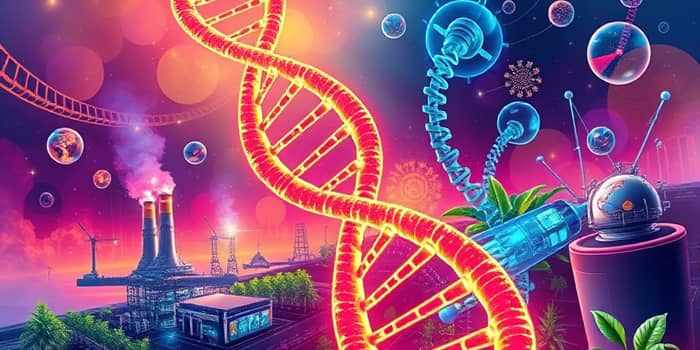
As we stand at the forefront of a new biotechnological era, engineered biological systems are hailed as the next industrial revolution. From healthcare breakthroughs to sustainable manufacturing solutions, synthetic biology is poised to deliver profound economic and societal benefits.
In this comprehensive exploration, we examine market trajectories, dissect key growth drivers, and illuminate the opportunities and challenges that will define this dynamic field over the coming decade.
The global synthetic biology market has witnessed remarkable acceleration. In 2025, valuations range from USD 16.35 billion to USD 23.88 billion, while 2026 projections span USD 18.25 billion to USD 30.70 billion. These figures underscore a burgeoning appetite for advanced biomanufacturing and next-generation therapies.
Long-term forecasts paint an even more dramatic picture. By 2032, analysts project a market size between USD 48.18 billion and USD 90.73 billion, reflecting compound annual growth rates from 17.2% to 22.5%. Projections for 2035 escalate further, ranging USD 96.66 billion to USD 142.42 billion, with CAGRs surpassing 22% in some scenarios.
This variation reflects differences in analytical scope, regional definitions, and sectoral assumptions. Nonetheless, the consensus is one of robust growth, driven by continuous innovation and expanding use cases.
A confluence of technological advancements and market demand underpins the rapid expansion of synthetic biology.
At the core, improvements in genome editing tools have democratized access to genetic engineering. Laboratories worldwide can now introduce targeted modifications at unprecedented speed, unlocking new therapeutic and industrial applications.
The dramatic reduction in DNA synthesis and sequencing costs has slashed barriers to entry. Projects that once required significant capital can now proceed with modest budgets, enabling startups and academic teams to innovate freely.
Design automation platforms integrate computational modeling with high-throughput screening, streamlining the validation of genetic constructs. This synergy heralds an era of next-generation predictive biological engineering.
Finally, cell-free systems—where biochemical reactions occur outside living cells—accelerate development by bypassing cellular growth constraints, significantly shortening prototyping timelines and reducing biosafety concerns.
North America’s leadership is rooted in a mature biotechnology ecosystem, world-class universities, and a regulatory environment conducive to rapid commercialization. The U.S. market alone is projected to surge from USD 5.85 billion in 2024 to over USD 41.26 billion by 2033, representing a 27.78% CAGR.
Asia Pacific is emerging as a powerhouse, with China, India, and Japan collectively investing billions into synthetic biology research. China’s market is valued at USD 0.76 billion in 2026, while India and Japan contribute USD 0.43 billion and USD 0.68 billion respectively. By 2035, the region could claim up to 24% of global market share.
Europe maintains moderate but steady growth, with the UK and Germany each projecting over USD 1.15 billion in 2026. Government subsidies, grant programs, and public-private consortia have fueled innovation hubs across the continent.
Other regions—including the Middle East, Africa, and Latin America—are beginning to leverage synthetic biology for personalized medicine and sustainable agriculture, signaling a truly global expansion of capabilities.
Synthetic biology’s transformative power spans both healthcare and non-healthcare sectors, each with unique drivers and market dynamics.
In healthcare, the emphasis is on personalized medicine growth. Novel synthetic vaccines, cell therapies, and diagnostic platforms are redefining treatment paradigms. By 2035, the healthcare segment is expected to command roughly 60% of the total market, propelled by breakthroughs in therapeutic genome editing and peptide-based drug development. Contract research and manufacturing organizations (CROs and CDMOs) play an essential role in scaling these innovations for global distribution.
Non-healthcare applications are equally compelling. From bio-based textiles and specialty chemicals to synthetic dyes and fragrances, engineered organisms deliver superior performance with lower environmental footprints. Agricultural uses—such as crop metabolic pathway renovation and microbial biofertilizers—enhance yield and resilience, while bio-manufacturing of bioplastics and biofuels aligns with corporate sustainability mandates. This expansion exemplifies circular economy and resource-efficient production models.
Investment in synthetic biology has surged, with global R&D spending climbing steadily. Strategic partnerships between startups, large corporations, and academic labs underpin a collaborative ecosystem. Governments across North America, Europe, and Asia Pacific are channeling funds into public-private initiatives, accelerating translational research and enabling market entry.
Sustainability considerations are central to this growth narrative. Corporate and regulatory commitments to reduce carbon footprints have elevated demand for bio-based alternatives replacing chemical synthesis. Biomanufacturing processes now rival traditional petrochemical methods in cost and efficiency, driving adoption across sectors. Green technologies—from biodegradable plastics to renewable biofuels—reflect synthetic biology’s promise as a catalyst for a low-carbon future.
Despite its promise, synthetic biology faces several challenges. Biosafety and biosecurity concerns demand stringent oversight, while ethical questions around genetic engineering require transparent stakeholder engagement. Intellectual property frameworks must evolve to balance innovation incentives with equitable access.
Regulatory harmonization remains critical. Divergent policies across regions can slow commercialization and complicate global supply chains. Addressing these issues requires a coordinated approach involving policymakers, industry leaders, and the scientific community.
Looking ahead, synthetic biology is poised to transition from an emerging discipline to a foundational industry pillar. The market is projected to expand threefold to tenfold over the next decade, reshaping biopharma, agriculture, materials science, and beyond. Advances in machine learning and automation promise to further accelerate discovery, while new business models—such as biodesign-as-a-service—will democratize access to cutting-edge capabilities.
Ultimately, the story of synthetic biology is one of convergence: of biology with engineering, of public goals with private innovation, and of economic growth with environmental stewardship. By embracing collaborative frameworks and responsible governance, stakeholders can unlock the full potential of this revolutionary field, delivering tangible benefits for global health, industry, and the planet.
The journey has only just begun, but the trajectory is clear: synthetic biology will reshape industries and markets in ways we are only beginning to imagine.
References