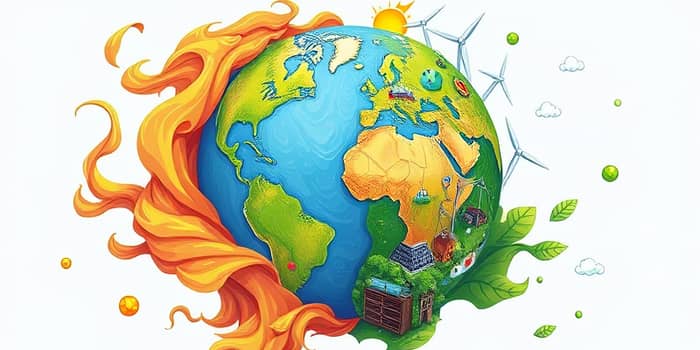
As global economies expanded throughout the late twentieth century, carbon emissions climbed with unprecedented force. From 1990 to 2025, total CO₂ output surged by over 60 percent, propelling atmospheric concentrations to nearly 426 parts per million by 2025—more than 50 percent above pre-industrial levels. This rise reflects the energy demands of booming populations, industrial production, and transportation, painting a complex picture of modern development’s costs and consequences.
In 2023, fossil fuel and industrial emissions reached 37.01 gigatonnes of CO₂, with projections of 37.41 gigatonnes in 2024 and a record-breaking 38.11 gigatonnes in 2025. When non-CO₂ gases like methane and nitrous oxide are included, total greenhouse gases soared to 53.2 gigatonnes of CO₂ equivalent in 2024—an increase of 1.3 percent year-over-year. These figures highlight the critical interplay between economic activity, energy consumption, and global commitments to climate stability.
Since 1990, the world’s carbon footprint has grown inexorably alongside GDP and population, except for brief downturns during crises. The financial crash of 2008 briefly eased emissions, and the COVID-19 pandemic in 2020 drove a temporary dip to 35.96 gigatonnes. Yet the rebound that followed underscores how quickly economies revert to fossil-intensive patterns without structural change.
Looking at monthly trends, January 2025 saw a marginal 0.6 percent reduction in CO₂ emissions compared to January 2024, led by emerging declines in China, the European Union, and select developed nations. This early sign suggests that policy interventions and technological advances can slow the curve when coupled with sustained commitment.
Concentrated economic activity and energy production drive a handful of nations to the forefront of global emissions. China alone accounts for roughly one-third of annual CO₂ output, emitting over 13.3 gigatonnes in 2023. The United States follows with approximately 4.7 gigatonnes, while India’s rapid development propelled its emissions upward by 165 megatonnes in 2024.
Yet per capita figures tell a different story. Small oil-dependent economies like Qatar and Kuwait report per-person emissions exceeding 24 tonnes annually, while India remains near two tonnes per person. These contrasts reflect divergent industrial structures, energy policies, and the scale of domestic consumption.
The energy sector—encompassing electricity generation and heating—remains the dominant source of emissions, responsible for more than three-quarters of global greenhouse gases. Within this realm, coal-fired power plants and natural gas infrastructure continue to release vast quantities of CO₂ annually.
The cost of standing still in the face of rising emissions is measured not only in warming temperatures but in economic disruptions, health impacts, and threats to food security. Unchecked emissions risk intensifying droughts, storms, and sea-level rise, placing trillions of dollars of assets at peril.
Conversely, targeted investment in low-carbon technologies unlocks dividends across economies. Studies estimate that every dollar directed toward renewables and efficiency returns multiple dollars in health savings, job creation, and avoided climate damage. The example set by the European Union and the United States—where emissions peaked and then declined post-2010—demonstrates the dividends of strong regulatory frameworks and market incentives.
Achieving meaningful reductions worldwide hinges on collaborative action among governments, businesses, and communities. Emerging economies must leapfrog to cleaner technologies, supported by finance and capacity building. Meanwhile, high-emitting nations need to uphold ambitious commitments and export best practices in energy efficiency and grid integration.
Local communities and private sector actors play a vital role, driving innovation and adoption of clean solutions through grassroots initiatives. When cities invest in efficient public transit and building retrofits, they demonstrate how collective action delivers tangible results. Likewise, financial institutions can steer capital toward green projects, leveraging public-private partnerships to de-risk investments in emerging technologies like green hydrogen, carbon capture, and advanced energy storage.
Key levers include scaling up renewable capacity, modernizing infrastructure through electrification of transport and heating, and phasing out unabated coal and oil facilities. Additionally, protecting and restoring forests can sequester vast quantities of carbon, complementing technological solutions.
Ultimately, the transition to a low-carbon economy represents both a formidable challenge and a profound opportunity. By weaving sustainability into the fabric of economic planning, societies can unleash innovation, create resilient jobs, and safeguard the planet for future generations. The journey demands unwavering global collaboration and solidarity and bold policy leadership and commitment, but the rewards—cleaner air, stable climates, and thriving communities—are well worth the effort.
In the coming years, the world will decide whether to cement a trajectory of escalating emissions or to pivot decisively toward sustainable growth. The data is clear, the risks are palpable, and the alternatives are within reach. Now is the time to act.
References