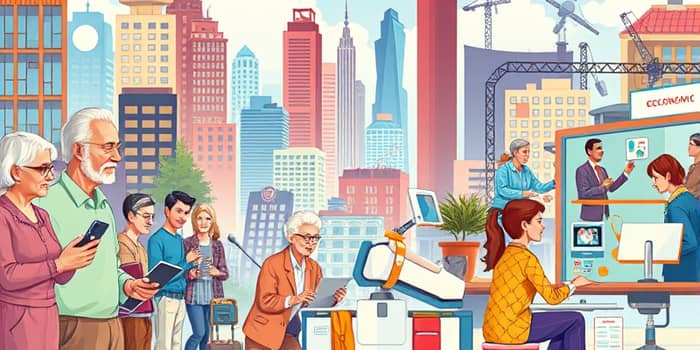
As the world witnesses one of the most profound shifts in its history, the interplay between age, work, and growth demands attention. From bustling urban centers to remote villages, an unprecedented global aging trend is reshaping societies and challenging economic models once considered unshakeable.
Declining fertility rates and rising life expectancy have combined to create a demographic crossroad. In the United States, the share of Americans aged 65 and older is projected to rise from 17% in 2022 to 23% by 2050. Globally, the population aged 60 and above will swell from 1.1 billion in 2023 to 1.4 billion by 2030.
These trends are not confined to advanced economies. Emerging markets from China to India face similar patterns, with China’s GDP growth alone expected to decelerate by 2.7 percentage points over 2025–2050 due to demographic aging. Policymakers and businesses must navigate this new reality without delay.
The retirement of Baby Boomers (born 1946–1964) signals a looming labor crunch. By 2030, the U.S. may experience a shortfall of 2.1 million skilled workers, forcing employers to adapt. Despite stable participation among prime-age workers, the overall labor force growth will slow to 0.5% per year between 2025 and 2035.
To sustain productivity, organizations are turning to automation, robotics, and artificial intelligence. Industries such as elder care and healthcare technology are attracting record investments, while immigration—accounting for over 100% of U.S. population growth after 2031—remains a critical buffer against a shrinking native-born workforce.
As people live longer and retire later, spending priorities shift. Americans aged 75 and over will drive a consumption surge of more than 80% by 2030, equating to a $700 billion increase. Expenditures on healthcare, home repairs, and services will eclipse traditional purchases like vehicles and fuel.
Real estate markets will experience mixed outcomes. While many seniors downsize, creating an oversupply of single-family homes, demand for rentals and purpose-built retirement communities continues to rise. Investors poised to meet these needs will reap significant returns.
Social Security and Medicare now consume 36% of federal spending, up from 24% five decades ago. Combined outlays are expected to climb from 9.1% of GDP in 2023 to 11.5% by 2035. With per capita healthcare costs for those aged 85+ almost double those for ages 65–84, fiscal stress intensifies.
Governments face difficult choices: raise taxes, cut benefits, or reform systems altogether. Without action, the growing dependency ratio—fewer workers supporting more retirees—threatens not only budgets but intergenerational equity and social cohesion.
Despite daunting numbers, demographic change can catalyze innovation. Healthy aging programs—focusing on prevention, wellness, and flexible work—can extend careers and reduce medical costs. Companies that embrace age diversity often experience higher productivity, creativity, and customer insights.
Automation and robotics, once feared as job destroyers, can instead complement human labor. By reallocating tasks and empowering older workers with ergonomic technologies, businesses can maintain service levels and capture new markets driven by senior spending power.
Communities and institutions must also address social dimensions. Combating loneliness, fostering intergenerational connections, and strengthening social safety nets will sustain cohesion and unlock the full potential of an age-diverse society.
Ultimately, the demographic revolution demands forward-looking policies and strategies. By aligning retirement ages with longevity, investing in health and skills, and leveraging technology, nations and businesses can transform a potential crisis into a powerful engine of growth.
References