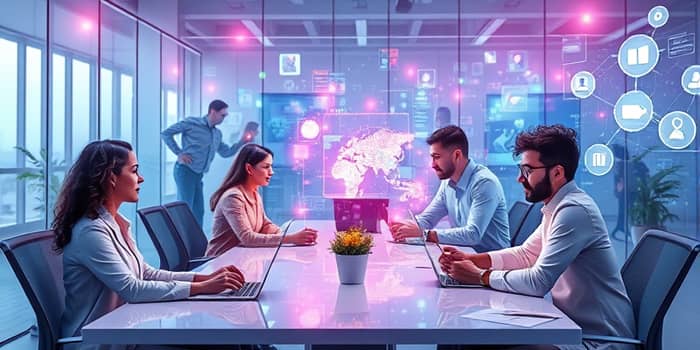
As global markets navigate rising unemployment and slowing economic growth under pressure, 2026 heralds a new chapter in how we conceive and execute work. The fusion of artificial intelligence with human creativity, combined with flexible models of engagement, is reshaping organizations. In this rapidly evolving landscape, agility and purpose become mandatory, and the ability to redesign roles around tasks and skills emerges as a competitive advantage. This article explores the trends driving the future of work and offers practical guidance for thriving amid change.
The interplay between technology, labor markets, and organizational culture is more pronounced than ever. Automation is displacing traditional white-collar roles even as demand for skilled blue-collar labor surges. Employers, confronted with cost pressures and fragmented global supply chains, are adopting hybrid staffing strategies that blend permanent employees, contractors, freelancers, and AI agents. By reframing success around outcomes rather than activity, companies can maintain productivity and foster innovation.
The global economy in 2026 is marked by uneven growth and persistent volatility. Advanced economies wrestle with high healthcare costs and inflationary pressures while emerging markets face capital constraints. Unemployment rates have edged upward in service sectors but remain tight in skilled trades. Governments and businesses must collaborate to address structural imbalances and recalibrate workforce development programs.
Job polarization intensifies as AI automates routine analytical tasks. Roles such as data entry, legal document review, and basic underwriting experience steep declines, whereas technicians, skilled tradespeople, and care workers see robust demand. This shift generates both anxiety and opportunity: workers displaced by automation must pivot through reskilling initiatives, while firms can tap into a growing pool of specialized talent to enhance operational efficiency.
The era of AI experimentation is over. Enterprises are now embedding intelligent systems into core workflows, enabling machines to handle data-intensive and repetitive tasks at scale. This transition allows human professionals to concentrate on judgment calls, creative problem-solving, and strategic decision-making. Successful adopters establish governance with explainability and audit trails to ensure trust and compliance.
AI ethics frameworks are critical in hiring, performance reviews, and compensation models. Transparent algorithms help prevent bias and reinforce public confidence. Continuous monitoring and periodic audits ensure that AI-driven outcomes align with organizational values and regulatory standards. By pairing robust governance with agile development cycles, companies can iterate quickly without sacrificing accountability.
Organizations increasingly embrace portfolio careers and fluid talent pools, mixing full-time employees, independent contractors, gig workers, and AI collaborators. Internal talent marketplaces facilitate skills-based matching, enabling staff to pivot between projects seamlessly. Community pipelines of freelancers and alumni networks ensure access to niche expertise on demand.
This always-on engagement with diverse talent fosters innovation and resilience. Firms that excel at orchestrating these ecosystems create a balance between stability and flexibility. They define clear outcome metrics, offer equitable pay structures, and maintain open communication channels that span multiple work arrangements, ensuring cohesion even in dispersed teams.
Hybrid work is the new baseline. With nearly half the global workforce operating remotely at least part-time, offices have transformed into collaboration hubs for training, brainstorming, and social connection. Companies deploy personalized schedules that balance heads-down focus with in-person interaction, optimizing space utilization and employee satisfaction.
Productivity metrics underscore the shift: remote workers maintain or exceed office-level output, and flexible arrangements boost retention, with 64% willing to quit if options are revoked. Yet managing distributed teams requires deliberate strategies for engagement and performance measurement, leveraging technology to unite people across time zones and geographies.
Key remote and hybrid work statistics for 2026:
Amid constant change, workers face disorientation more than disengagement. Leading companies prioritize psychological safety, belonging, and clear paths for career advancement. They invest in structured mentorship, peer communities, and purpose-driven initiatives that connect day-to-day tasks to broader societal impact.
Enablement—providing clarity, tools, and energy—outweighs traditional engagement tactics. Transparency around strategy and trust in employee autonomy nurture a culture where individuals feel valued and empowered to adapt alongside AI colleagues. Organizations that succeed in this space embed values as observable behaviors rather than abstract statements.
Talent acquisition has shifted from credentials to capabilities. Employers craft roles around discrete tasks and critical skills, deploying AI-driven platforms for precise matching. Upskilling programs and project-based assignments bridge competency gaps, ensuring that employees continuously evolve in line with business priorities.
Performance assessments now emphasize measurable deliverables and measurable outcomes-oriented performance metrics. Compensation frameworks reward learning achievements and cross-functional contributions, not just tenure or title. This dynamic approach democratizes opportunities and fosters a growth mindset across the organization.
Middle managers have emerged as linchpins in orchestrating distributed workflows. Equipped with self-service analytics tools, they monitor real-time progress against objectives, adjust resource allocation, and coach teams through complex problem-solving. Their role expands from task oversight to talent development and change leadership.
By delegating routine decision rights and providing guidelines for escalation, managers cultivate a sense of ownership among team members. This real-time outcome measurement and feedback loop accelerates innovation and reduces bottlenecks, enabling rapid responses to market shifts.
By integrating these strategic imperatives, organizations can harness the complementary strengths of humans and machines. This synergy not only boosts efficiency but also cultivates a resilient and motivated workforce.
In conclusion, the future of work in 2026 is not a mere extension of the past but a fundamental transformation. Companies that embrace human-AI collaboration with ethical oversight, design fluid workforce architectures, and center culture and skills in their strategies will lead the next wave of sustainable growth. As we navigate economic uncertainties and technological breakthroughs, the organizations that thrive will be those that balance innovation with empathy, agility with stability, and data-driven insights with human judgment.
References