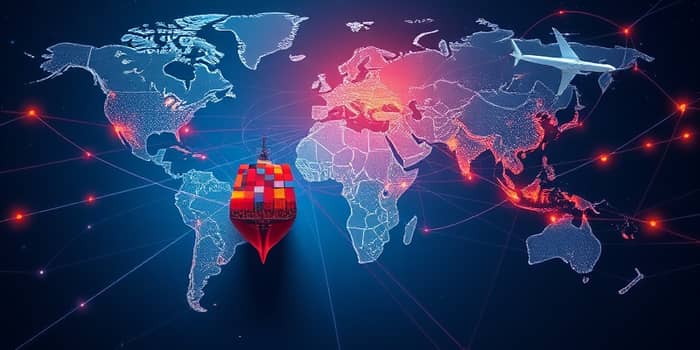
In 2025, supply chains have evolved beyond logistics and commerce into arenas of intense geopolitical competition. The interdependence of nations, industries, and digital infrastructures has created a landscape where economic dynamics and power plays are inseparable. Understanding these shifts is crucial for businesses, policymakers, and citizens navigating the uncertainty of a new global order.
As the world emerges from the pandemic’s aftermath, persistent inflation and logistical bottlenecks dominate headlines. The World Economic Forum reports that 56% of leading economists predict weaker global growth in 2025, driven largely by supply chain disruptions. These disruptions amplify production costs, delay deliveries, and create shortages of intermediate goods, triggering stagflation-like effects on producers in key sectors like semiconductors and heavy machinery.
Inflationary pressures are not evenly spread. Producer prices have climbed more sharply than consumer prices, signaling that upstream cost spikes are cascading through the entire value chain. As central banks grapple with rising prices and slowed output, the traditional toolkit of monetary policy faces unprecedented complications in an environment where supply, not demand, is the primary constraint.
Conflicts and rivalries have become critical flashpoints in 2025. The ongoing Russia-Ukraine war and fresh tensions in the Middle East threaten energy and food security, while skirmishes in the South China Sea force rerouting of maritime traffic. Commercial shipping avoids the Red Sea and Bab-el-Mandeb straits by circumnavigating Africa, adding weeks and millions of dollars in costs.
In parallel, superpower rivalries fuel friendshoring and reshoring trends, as companies seek politically aligned partners. China’s strategic investments in technology and military capacity challenge US dominance, reshaping procurement decisions across industries.
Supply chains are no longer just physical networks; they are digital ecosystems vulnerable to attack. Escalating state-sponsored cyberattacks on supply infrastructures target logistics hubs, payment systems, and critical databases. From ransomware strikes on port authorities to espionage aimed at semiconductor blueprints, cyber warfare has become a tool for economic coercion.
To counter these threats, firms are prioritizing cybersecurity investments and collaborating with government agencies. Robust encryption, real-time monitoring, and incident response teams have become essential components of supply chain defense. Yet the attack surface continues to expand as IoT devices and smart sensors proliferate in warehouses and transport fleets.
In response to mounting risks, companies are deploying a range of tactics designed to bolster reliability and flexibility. Emphasis on diversification and localization strategies helps mitigate the impact of regional disruptions. Many firms now maintain larger safety stocks, multiple sourcing agreements, and backup manufacturing sites across continents.
Technological innovation is at the heart of resilience efforts. The adoption of advanced analytics for supply chain visibility allows predictive risk assessment, real-time route optimization, and automated response protocols. Blockchain pilots aim to strengthen traceability, while AI-driven forecasting reduces uncertainty surrounding demand and supply fluctuations.
Governments and central banks face a delicate balance. On one hand, policymakers seek to strengthen supply chain resilience through grants, tax incentives, and strategic stockpiles. On the other hand, they must temper inflation without stifling growth in an environment where supply constraints limit the effectiveness of rate cuts or hiking cycles.
Regulatory frameworks are adapting to support domestic manufacturing of critical goods, from semiconductors to pharmaceuticals. At the same time, trade agreements are being renegotiated to include clauses on data security, labor rights, and environmental standards, reflecting the intertwined nature of economic and geopolitical objectives.
As we look beyond 2025, a new economic order is crystallizing. Power is coalescing around a handful of multinational corporations that control vast segments of global value chains. These firms wield unprecedented influence over supplier pricing, technology adoption, and geopolitical alignment.
Simultaneously, the race for critical minerals, green technologies, and advanced AI is intensifying. Climate change, resource scarcity, and regulatory pressures are driving innovations in circular supply chains and regional cooperation frameworks, particularly in the Asia-Pacific region.
Ultimately, success in this evolving landscape will hinge on agility, collaboration, and foresight. Companies and governments that embrace adaptive strategies—blending technological prowess with geopolitical awareness—will be best positioned to thrive in a world where supply chains are the new frontier of economic power.
References