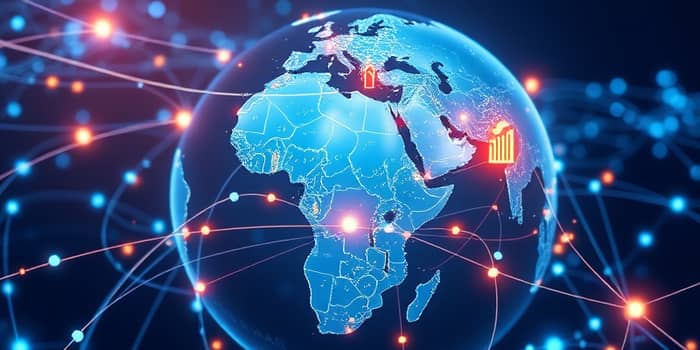
In an era where every transaction echoes across borders, understanding the ties that bind our economies together has never been more essential. The global financial grid represents a living network of capital, risk, innovation, and promise. This article journeys through the architecture, challenges, and opportunities of this interconnected landscape, offering you practical insights to navigate and thrive in a world where ripples of change can become powerful waves of impact.
At its core, financial interconnectedness is the complex web of cross-border connections that threads together markets, institutions, and economies. It explains how a single event—be it a policy change, a liquidity shock, or a technological innovation—can travel at lightning speed from one continent to another.
This dynamic environment means that local financial shocks and events no longer remain confined. Instead, they can be amplified, morphing into global disturbances that test the resilience of systems and communities far from their origin.
The backbone of global finance is built around a small group of jurisdictions and institutions. Approximately 20 key large, complex financial institutions (LCFIs) dominate cross-border intermediation, acting as conduits for capital flows.
Within this architecture, a handful of economies serve as common lenders and borrowers, creating central nodes that link a myriad of countries. These core economies not only facilitate investment but also serve as channels through which policy shifts and market disturbances radiate outward.
Certain market sectors function as powerful connectors, weaving together disparate parts of the global grid. Their influence has grown significantly over time, driven by expanding global demand and evolving trade patterns.
Amid traditional banking structures, nonbank financial institutions (NBFIs) have emerged as pivotal players. The rapid growth of nonbank financial institutions has reshaped the contours of systemic risk.
Today, NBFIs account for nearly half of global financial assets. Exposures are significant, with European banks reporting over 10% of total assets tied to these entities and U.S. banks showing similar figures for loans.
High leverage, reliance on wholesale funding, and interconnected balance sheets have led to deteriorating counterparty risk profiles. As bankruptcy cases surface, the need for robust oversight and stress testing becomes ever more pressing.
The dawn of instantaneous transactions marks a revolutionary shift. Real-time payments will continue to reshape expectations, reducing settlement time from days to seconds and fostering new financial services.
These advancements not only speed up commerce but also provide richer data streams, enabling smarter decision-making for businesses and regulators alike.
Beyond fiat currencies, a spectrum of digital assets is emerging, from stablecoins to tokenized securities. Market participants are exploring tokenized real-world assets and liabilities to boost efficiency and liquidity.
The concept of a coexistence of multiple digital and traditional currencies envisions a future where traditional bank deposits, central bank digital currencies, and stablecoins operate seamlessly, freely exchangeable through interoperable rails. However, the linchpin is clear: interconnectivity between traditional and digital systems is essential to unlock full potential.
In response to evolving risks, regulators are intensifying scrutiny. Enhanced transparency and scrutiny of non-banks and their interaction with the real economy aim to safeguard stability.
Simultaneously, banks are forging strategic partnerships with fintech companies to diversify offerings and capture new market segments. Collaborations span continents—from Africa to Asia—blending innovation with established expertise.
The 2008 crisis underscored the dangers of concentrated risk and opaque funding channels. Historical systemic risk lessons remind us that unchecked interconnections can become fault lines for contagion.
Today, policymakers emphasize macro-prudential surveillance, guiding institutions to map exposures, conduct stress scenarios, and erect firewalls against cascading failures.
Modern finance demands not just connectivity but productivity in data exchange. Transitioning from siloed ledgers to interconnected real-time data flows empowers banks, regulators, and corporates to anticipate trends and respond swiftly.
Key steps include standardizing data formats, investing in secure cloud architectures, and developing analytics tools that turn raw payments data into strategic insights.
With complexity comes opportunity. To thrive amid interconnected risks and innovations, organizations and individuals can adopt pragmatic approaches:
By combining measured risk management with creative adoption of new technologies, stakeholders can transform uncertainty into growth catalysts.
As we navigate the global grid, we stand at a crossroads between fragmentation and unity. Collective commitment to innovation, transparency, and robust oversight can steer us toward a horizon where capital flows uplift communities and power transformative projects around the world.
Together, we have the tools to build a resilient and inclusive global finance landscape—one where every node in the network, from emerging startups to established banks, contributes to a shared vision of prosperity and stability.
Let this interconnected age be defined not by its risks, but by the creativity and collaboration it inspires. The threads of our financial world are yours to weave into a tapestry of opportunity.
References