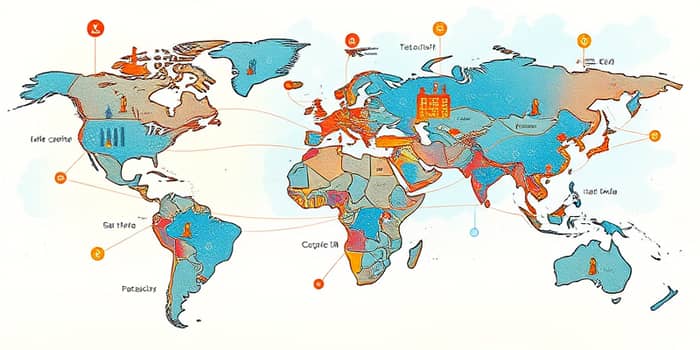
In an era defined by rapid technological progress and ever-falling transportation costs, the global economy has undergone profound transformations. Richard Baldwin’s framework of the “Great Unbundling” captures how successive phases of globalization have dismantled traditional industrial structures, enabling spatial disaggregation of economic activities across continents. By separating production stages through falling costs in goods, ideas, communication, and coordination, this paradigm shifts competition from firms and sectors to individual tasks and workers.
The Great Unbundling unfolds through three distinct phases, each driven by breakthroughs that reduce barriers to trade and collaboration. Recognizing these phases helps businesses, policymakers, and workers prepare for the next wave of innovation and competition.
During the First Unbundling (1870–1914, later 1960–1995), steamships, railroads, containerization, and air cargo sharply cut goods trade costs. Production sites clustered near raw materials or labor pools, while consumption markets globalized. Although production separated from consumption, high communication costs meant that innovation remained concentrated in Northern economies. This era laid the foundation for global markets but preserved local knowhow monopolies.
The Second Unbundling (post-1990), fueled by the ICT revolution and the internet, fragmented production within firms and industries. Manufacturing stages and service inputs were unbundled and offshored, creating intricate complex global value chains. Ideas and processes decoupled from manufacturing, and major corporations pursued the offshoring of manufacturing and services to low-wage regions. This shift marked the rise of a true “global factory,” where individual tasks crossed borders more freely than ever before.
Emerging now is the Third Unbundling, powered by telepresence, telerobotics, advanced data transfer, and human-machine interfaces. These technologies erode the cost of face-to-face interaction, enabling full unbundling of service and office tasks. From remote design studios to cross-border legal teams, competition now operates at the task-level competition on a global scale, democratizing access to opportunities but intensifying pressure on every worker and region.
The Great Unbundling democratizes access to global markets but also creates winners and losers. Historically, unskilled, labor-intensive tasks moved to low-wage economies, while skilled, innovative tasks remained clustered in high-income regions. This diverse high-tech-low-wage production mix boosted emerging economies, lifting nearly a billion people out of poverty between 1990 and 2014. However, it triggered de-industrialization in parts of the North and left many workers facing abrupt dislocation.
Competition at the task level means that individuals, not just firms, must continuously adapt. Engineers in Silicon Valley, designers in Berlin, and factory technicians in Vietnam now vie for similar tasks on a global stage. For firms, integrating disaggregated production stages offers cost efficiencies but demands robust coordination, resilient supply chains, and digital infrastructure to manage complexity and risk.
By implementing these strategies, businesses can navigate the complexity of global value chains and leverage the unbundled structure to optimize efficiency and foster innovation. Individuals, meanwhile, can secure their professional relevance by specializing in high-value tasks and embracing a mindset of perpetual growth.
Governments that embrace the full spectrum of unbundling—from goods and manufacturing to services and digital tasks—will position their societies to thrive in a hyperconnected world. Predictable regulations, targeted support, and a focus on individual adaptability form the pillars of resilient economic policy in the age of unbundling.
The Great Unbundling is not a one-time event but an ongoing process that will intensify as new technologies emerge. Artificial intelligence, digital twins, and advanced robotics promise to further reduce coordination costs and expand the frontier of detachable tasks. Forward-thinking leaders will harness these tools to design more inclusive, sustainable, and resilient production ecosystems.
By weaving together human ingenuity, technology, and global collaboration, we can construct value chains that deliver prosperity across regions and skill levels. This vision demands bold investment in education, infrastructure, and digital platforms that bridge geographic divides. It calls for a collective commitment to ensuring that every worker has the opportunity to contribute meaningfully, grow professionally, and share in the benefits of globalization.
As we stand at the cusp of the Third Unbundling, the choices we make today will shape the economic landscape for generations. Let us seize this moment to craft policies, business models, and personal strategies that harness the unbundling’s transformative power—building a future where innovation and opportunity flow freely, unbound by distance or tradition.
References