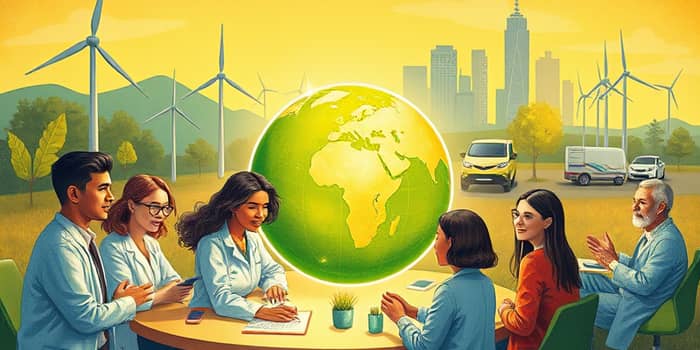
As global challenges mount—from climate change to economic inequality—an unprecedented opportunity is emerging at the intersection of sustainability and prosperity. Industries around the world are harnessing clean technologies, innovative financing models, and policy momentum to rewrite the rules of growth.
This article explores how companies, governments, and communities can embrace the green transition, tapping into transformative investments and pioneering strategies to thrive in a rapidly evolving landscape.
Before delving into specific strategies, consider the scope of this revolution: the world is reimagining growth not just as an economic imperative, but as a force for environmental restoration and social equity.
The scale of the green economy is staggering. The global green economy has reached $5 trillion in annual revenues, and it is projected to surpass $7 trillion by 2030. Investors are rewarding sustainability: firms active in clean markets enjoy growing twice as fast as conventional sectors and capture a 12–15% valuation premiums with investors.
Global investment in sustainable energy climbed from $2.1 trillion in 2024 to $2.3 trillion in 2025, led by China’s $800 billion commitment—equivalent to 4.1% of its GDP. Clean energy now accounts for over 10% of China’s economy ($1.9 trillion), reinforcing the economic case for decarbonization.
Cost declines have propelled renewables and storage into the mainstream. Over the past decade, solar and batteries down 90% since 2010 and offshore wind costs dropped by half. Mature technologies are now cost-competitive globally in renewables, enabling 55% of today’s emission reductions at no net cost.
In the United States, renewables represented 61% of new power capacity in 2025—27 GW of solar and a 30% year-on-year rise in onshore wind. Electric vehicle production has surged sixfold, while emerging segments like clean hydrogen are poised to reach 125–585 million tonnes per year by 2050.
Effective policy remains a catalyst. COP29 set a $300 billion mobilization goal, even as experts estimate $1 trillion is needed annually to meet net-zero targets. Governments are responding: the UK committed £30 billion to domestic green initiatives (2021–2023), and the EU’s Net-Zero Industry Act aims to support 350,000 jobs in wind, solar, and battery manufacturing.
In parallel, emissions trading schemes are expanding—covering maritime shipping by 2026 and waste processing by 2028—while 26% of leading companies now pursue three or more nature-positive goals. Despite extreme weather costs hitting $800 billion globally in 2025, green sectors continue to attract capital and talent.
Certain regions are setting the pace. China leads with 60% of new renewable capacity through 2030 and commands the bulk of global patents in solar, EVs, and battery technologies. The UK boasts Europe’s top tech ecosystem—over $1 trillion in valuation and 3 million jobs—with 40% of the continent’s climate-focused venture capital.
Meanwhile, Uganda generates 99% of its electricity from hydropower, South Asia posted 5.6% growth (India at 6.6%), and Africa’s economies expanded by 4.0%, demonstrating that sustainable development can drive broad-based prosperity.
Despite remarkable progress, headwinds remain. Emerging technologies like low-carbon hydrogen and carbon capture require unwavering policy support and collaboration to scale. In the United States, greenhouse gas emissions rose by 1.7% in 2025, even as power-sector emissions fell 39% since 2005.
Geopolitical tensions, debt burdens, and climate shocks threaten global growth, which the IMF and OECD forecast at 3.3% and 2.9% respectively in 2026—below pre-pandemic levels. Bridging these gaps will demand creativity, resilience, and a shared vision for a sustainable future.
Leaders can seize this moment by embedding purpose, innovation, and impact into every decision. Consider these strategic priorities:
The shift toward a sustainable global economy is neither hypothetical nor distant. It is unfolding now, reshaping industries, energizing communities, and offering transformative economic opportunities await those bold enough to lead.
By uniting finance, technology, policy, and human ingenuity, businesses and governments can build a future defined by decarbonization, inclusion, and shared prosperity. The time to act is today—because the world’s largest growth story is a green one, and its benefits are within reach.
References