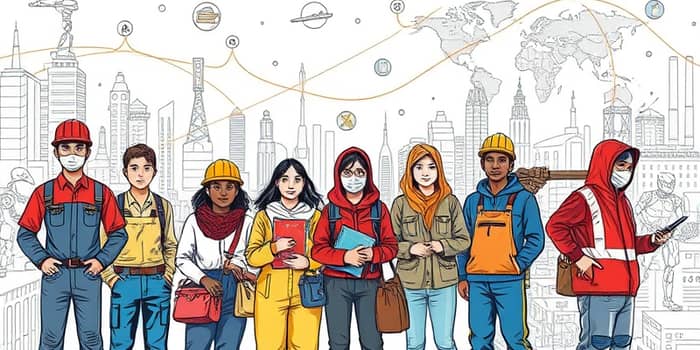
As the world enters 2026, headline figures hold steady: global unemployment at 4.9%, employment-to-population ratio inching up to 59.3%. Yet beneath this veneer lies a more complex reality—nearly 300 million people living in extreme poverty and 2.1 billion working informally without protection or benefits. This article examines how these global economic shifts impact real lives and what we must do to ensure a just transition for all.
In 2025, four million new positions were added worldwide, leading to a slight uptick in formal employment. However, growth remains uneven: low-income countries saw 3.1% job gains, while upper-middle-income economies managed only 0.5%. Wage growth in certain regions has outpaced pre-pandemic highs, but job quality often lags behind.
Among key challenges:
Across advanced economies, market stabilization contrasts sharply with emerging regions. In the United States, unemployment peaked at 4.5% in early 2026, monthly payroll gains slowed to 15,000–50,000 jobs, and immigration restrictions have tightened the labor supply. Meanwhile, Canada faces medium-term uncertainty as policy debates intensify.
In Europe, Germany’s moderate job growth is driven by government investments and an aging population seeking to fill labor shortages, while France contends with political volatility and slowing demand. The UK market remains cautious: employers hire selectively even as select industries thrive.
Asia-Pacific unemployment stands at 4.1%, down from 5.1% a decade ago, yet youth urban joblessness in China soared to 17.8% by mid-2025. Manufacturing employs 16.1% of the region’s workforce, but productivity gains vary widely. Sub-Saharan Africa, with 90% informal work and over half of workers in moderate poverty, lags far behind.
Youth remain the most exposed: Latin America’s young jobless rate of 11.9% dwarfs the adult rate of 4.3%. Women face persistent gaps in earnings and leadership roles, while migrants and informal vendors endure precarious conditions. Globally, 300 million live on less than $3 a day.
AI and digitalization have become double-edged swords: algorithms streamline recruitment but also risk bias and exclusion. Job postings referencing AI climbed sharply in 2025, yet layoffs in AI-exposed roles outpaced productivity gains, taking a toll on morale—especially among younger cohorts.
Employers increasingly pivot to skills-based hiring, valuing skills over traditional academic degrees and offering remote or hybrid work models. Talent intelligence platforms now analyze workforce capabilities in real time, guiding learning investments and strategic redeployment.
International organizations emphasize that technology gains must be matched by policy safeguards. The ILO advocates for investments in education and infrastructure, gender-responsive labor policies, and strengthened social protections.
At the national level, measures such as transparent salary frameworks, public–private upskilling initiatives, and targeted youth employment schemes can mitigate disparities. Yet without investments in education and infrastructure and coordinated trade and labor regulations, gains in productivity risk widening the gap between haves and have-nots.
The transition from 2025 to 2026 underscores cautious optimism. U.S. payrolls, once averaging 50,000 new jobs monthly, eased to 29,000; global GDP growth remains modest but positive. Yet trade tensions, mounting public debt, and the specter of rapid AI adoption pose risks.
In the words of JPMorgan analyst Mike Feroli, "Businesses are hesitant and unsure what the next six months might hold." This uncertainty calls for bold leadership, with firms and governments forging partnerships that bridge skill gaps and foster inclusive growth.
Ultimately, the human element must guide our strategies. By blending technological innovation with compassionate policy design, we can build a labor market that offers dignity, opportunity, and security for every worker—today and into the future.
References