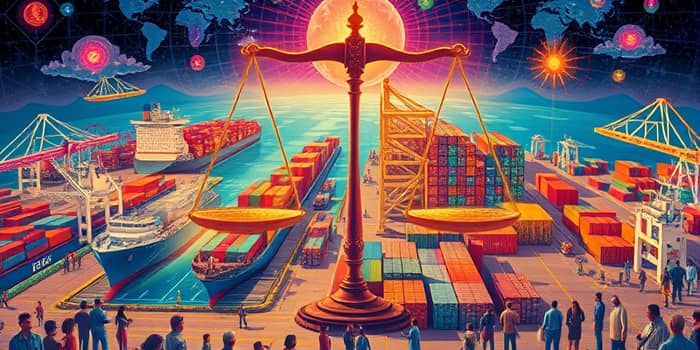
In an interconnected world, trade tariffs have emerged as potent tools of economic policy and geopolitical strategy. While they promise protection for some, they impose unseen costs on many others. This article unpacks the complex politics of tariff battles, the real winners and losers, and offers practical guidance for consumers, businesses, and policymakers navigating this shifting landscape.
Tariffs are taxes imposed on imported goods, functioning as an extra cost added when products cross a border. They are typically calculated as a percentage of an item’s declared value, affecting everything from steel beams to smartphones. Governments deploy tariffs to protect domestic industries, generate revenue, or leverage bargaining power in negotiations.
Beyond simple protectionism, tariffs can serve strategic objectives:
Within any tariff regime, the impacts are uneven. Some domestic groups benefit directly, while others shoulder the financial burden.
In the United States, combined 2025 tariffs have lifted overall price levels by 2.3%, translating into an average household loss of $3,800. Lower-income families bear a disproportionate share, losing up to $1,700 annually.
No economy operates in isolation. When one country raises tariffs, others often retaliate, and third-party nations can either suffer or seize new opportunities.
Interestingly, so-called “bystander” countries including Mexico, Taiwan, and parts of the EU have increased exports to the United States by diverting trade that once flowed from China.
Econometric models project that U.S. real GDP growth in 2025 will be 0.9 percentage points lower due to tariffs and retaliation, with persistent output losses of 0.4% to 0.6% in the long run—amounting to roughly $160 billion annually.
Exports could shrink by over 18%, while dynamic revenue effects may actually reduce budget inflows by around $366 billion over ten years, once slowing economic activity is considered. The White House estimates that every percentage point of lower growth can cost the federal budget about $4 trillion over a decade.
Tariffs function as a regressive economic burden, disproportionately affecting lower-income households who spend a larger share of their income on imported goods. In the long run, while capital owners may share more of the burden, the initial impact remains harshest on vulnerable populations.
Rather than passively absorbing the fallout, consumers, businesses, and policymakers can adopt strategies to mitigate risks and harness opportunities.
By taking proactive steps, stakeholders can reduce vulnerability, foster resilience, and position themselves to benefit when trade tensions ease.
Trade tariffs will remain a fixture of global economic policy as nations balance domestic interests with international obligations. Achieving an equilibrium that protects critical sectors without unduly punishing consumers or sparking retaliatory spirals is no small feat.
Transparent dialogue among governments, businesses, and civil society is essential. Combining economic analysis with diplomatic engagement can help craft smarter policies that distribute costs more equitably and preserve the dynamism of global markets.
The politics of trade tariffs present both challenges and opportunities. While certain industries and nations may emerge as temporary beneficiaries, the broader economic and social costs can be steep. By understanding the mechanics, recognizing the stakes, and adopting adaptive strategies, stakeholders can navigate these turbulent waters and work toward a more balanced global trading system.
Ultimately, informed citizens and forward‐thinking leaders can turn tariff conflicts into catalysts for innovation, cooperation, and stronger trade frameworks—ensuring that the true winners are not just a select few, but societies as a whole.
References