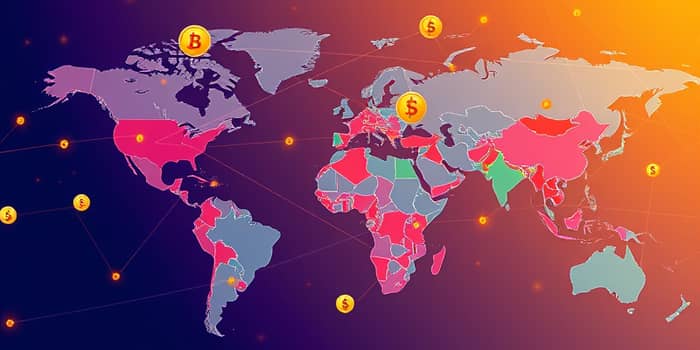
In an era of rising trade tensions and shifting alliances, the strength of global economies increasingly depends on how effectively they can leverage diversified partnerships and adapt to new frameworks. As 2026 unfolds, nations are reconfiguring their connections to weather headwinds and propel shared prosperity.
Forecasters paint a cautiously optimistic picture for 2026. Policy easing, tax reforms, and technology investment underpin a projected sturdy global GDP expansion, though trade barriers and regional divergences temper the outlook.
Key growth drivers include US tax cuts delivering consumer refunds boosting income, German fiscal stimulus, and robust services exports. Countervailing forces—job growth still below 2019 levels and climate-related shocks—signal the need for coordinated policy responses.
Global trade volume, after a 4.2% surge in fiscal 2025, is expected to moderate in 2026. Asia continues to lead, while the eurozone grapples with energy costs and structural challenges.
Chinese exporters are diversifying markets, with Vietnam emerging as a re-export hub. Meanwhile, record Chinese surpluses near $1.2 trillion in 2025 put pressure on European manufacturers.
These networks create buffers against disruption, directing trade along more predictable channels and supporting supply-chain resilience.
The United States, representing 14% of global imports, has seen service exports rise to $1.235 trillion in 2025, led by business services. Real goods exports climbed 3.2% to $1.788 trillion, while imports rose 4.2% to $2.984 trillion.
These shifts reflect both ongoing demand in high-tech sectors and the reorientation of supply chains toward allied partners.
Since 2021, the US has negotiated or implemented frameworks with Malaysia, Cambodia, and Vietnam, while reviewing USMCA in mid-2026. Temporary exclusions on China tariffs extend to November 2026, with export controls on key technologies lasting into year-end.
Elsewhere, the EU pursues tentative pacts with India and Mercosur, Mexico leverages over 50 FTAs, and regional blocs in Asia deepen ties. This intensified policy coordination fosters market certainty despite geopolitical headwinds.
Across geographies and industries, the interplay of network design and national strategy defines growth trajectories:
In financial services, tokenized payment systems trial in Brazil, Russia, and Australia complement live platforms in China and India, foreshadowing new cross-border settlement paradigms.
Despite positive momentum, risks persist. Geopolitical fragmentation, potential trade boycotts, and weakening multilateral institutions could undermine gains. UNCTAD warns of a lower-growth trap without deeper coordination.
To navigate this landscape, policymakers and businesses must:
By embracing network-driven strategies, stakeholders can transcend individual barriers. Bilateral pacts lower trade costs, regional blocs provide diversified markets, and tech partnerships spur joint R&D—together forging a more stable growth trajectory.
In 2026, the global economy stands at an inflection point where connectivity is both a shield and a catalyst. Nations that actively reconfigure their trade and payment networks, deepen policy coordination, and harness technology will lead the next wave of sustainable prosperity.
Ultimately, the power of networks lies not only in the ties they create but in the collective resilience they foster. As challenges evolve, so too must our collaborations—ensuring that shared growth remains within reach for every participant in the global economy.
References