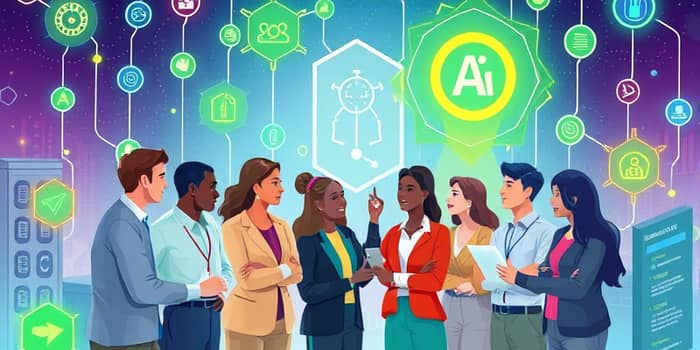
In a world where AI, automation and green technologies are reshaping every industry, the call to reskill has never been more urgent. Organizations and individuals must embrace massive workforce transformation on the horizon to thrive in the coming decade.
This article unpacks global trends, actionable strategies and inspiring initiatives designed to empower one billion people by 2030. Discover how you can take part in this cascading wave of change, transforming uncertainty into opportunity.
By 2030, disruptions will touch 22% of all jobs, displacing 92 million roles while creating 170 million new opportunities. These shifts demand continuous skill development across every role, spanning technical, human-centric, foundational and green competencies.
Yet only 0.5% of global GDP is invested in adult learning, leaving 1 billion people without access to the resources they need. Increasing investment could add $6.5 trillion to the global economy by 2030, with school-level education contributing an additional $2.54 trillion. Today, 59% of the workforce will require training by 2030, including 29% upskilling within their current roles. Despite this, just 36% of organizations are deemed widely recognized career development champions, and 11% of employees risk missing out on reskilling entirely.
Several forces converge to reshape work:
Technological change is at the forefront. AI, big data, agentic systems and robotics are shortening skill lifespans and altering workflows. Around 39% of core skills will evolve in the next few years.
The green transition is fueling demand for sustainable practices, clean energy trades and carbon management roles. Over half of Reskilling Revolution efforts are dedicated to building this workforce.
Demographic shifts, including lower fertility rates and looming retirements, threaten leadership and technical pipelines. Meanwhile, foundational skills in literacy, numeracy and problem-solving remain stagnant.
Geoeconomic fragmentation and reshoring amplify the need for skilled tradespeople, infrastructure experts and digital literacy champions. Finally, skills gaps persist: 63% of employers cite them as their biggest barrier to transformation.
Launched by the World Economic Forum, the Reskilling Revolution aims to empower one billion people by 2030 through over 350 partner organizations. Since its inception in 2020, commitments have impacted 856 million learners across digital, leadership and green skill domains. To date, 22 Skills/Education Accelerators have reached over 6 million individuals, laying the groundwork for scalable, high-impact interventions worldwide.
Champions include more than 35 CEOs, government leaders and civil society influencers, united through communities such as the Future Skills Alliance and Education 4.0. Notable efforts include Brazil’s SENAI programme, which has enrolled 4.4 million learners towards an 8 million target, and global businesses like Salesforce (16 million learners), Cisco (25 million learners) and SAP (12 million learners). Companies such as Workday, JD.com and Telefónica are also pioneering AI-driven labs and rural learning hubs.
National plans in India, Nigeria and Bahrain will launch in 2026, further expanding reach. Looking ahead, priorities for 2026–2027 revolve around strengthening education-talent systems, scaling future-critical skills and forging seamless employer-education pathways that accelerate career transitions.
To close execution gaps and foster a lifelong learning culture in organizations, leaders can adopt these approaches:
In a rapidly shifting labor market, individuals must adopt a proactive mindset. Cultivate career resilience and growth by:
With 11% of workers at risk of missing reskilling entirely, a structured personal plan can ensure you stay ahead of automation and economic shifts.
The reskilling imperative is not just a response to technological disruption; it is a gateway to brave new opportunities for generations in a sustainable, inclusive economy. When employers and individuals unite around continuous learning and adaptation, we unlock the potential to revitalize industries, close inequality gaps and create meaningful careers.
As we advance toward 2030, every stakeholder—governments, businesses, educators and learners—must champion transformative learning ecosystems. By investing in people, we invest in a future where work is reimagined, communities thrive and global prosperity is shared.
Embrace the challenge. Embark on the journey. Together, we can turn the reskilling imperative into a lasting legacy of innovation, equity and impact.
References