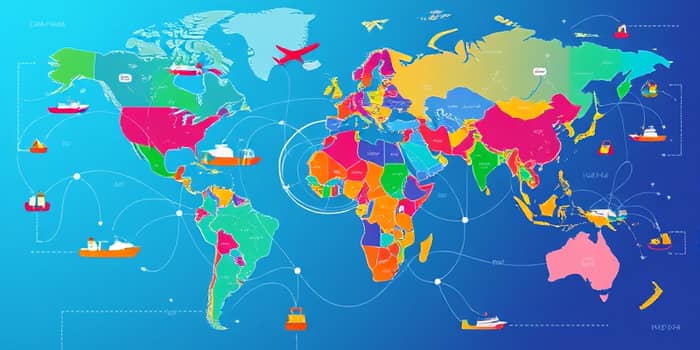
As the world emerges from the breakneck expansion of 2025, the contours of global commerce are being redrawn. What once seemed an unstoppable surge has given way to a deliberate, strategic realignment. Far from collapsing, trade is transforming into a patchwork model of regional integration that prioritizes resilience over raw volume.
In this detailed exploration, we examine the forces reshaping trade, the new alliances forging ahead, and the practical steps businesses can take to thrive in a more complex environment.
During the first half of 2025, companies frontloaded purchases to avoid escalating tariffs. Imports to the United States jumped by over 50% in Q1 as businesses sought to dodge new duties. Meanwhile, China maintained its role as the world’s factory by diverting exports through hubs in Vietnam, South Korea, and Southeast Asia.
Despite geopolitical tensions, global trade volume rose by 4.2% year-on-year, pushing total trade above $35 trillion. This resilience reflected companies leveraging in-transit exemptions and dynamic supply chain networks. Yet by Q3, exhaustion set in: the surge flattened, and protective measures took hold.
Europe watched its external trade stagnate, while the Global South’s intra-regional commerce soared. South-South exports reached $6.8 trillion, accounting for over 57% of developing world shipments. In every region, businesses learned that agile rerouting beats one-size-fits-all planning.
Projections for 2026 indicate a more modest expansion: 0.5–2.5% growth in trade volume. Tariff peaks in the U.S. rose to an average of 13% early in the year, and key agreements, such as certain U.S.-China exemptions, are set to expire by November.
Still, it is not all headwinds. Data center construction and semiconductor demand continue to buoy electronics shipments. The Mercosur-EU agreement, while delayed, promises phased tariff reductions that could unlock agricultural and mineral exports after 2026.
Businesses should focus on:
By adopting a multi-market strategy with built-in flexibility, companies can transform challenges into competitive advantages.
The globe is no longer dominated by a single trade superhighway. Instead, multiple corridors are weaving together:
Within this mosaic, winners include Vietnam, India, Indonesia, and Brazil. Industries anchoring in these markets can exploit new corridors to high-growth regions, offsetting declines in traditional partners.
This table encapsulates the shift from broad-based growth to targeted expansion. It reaffirms that while overall momentum slows, certain regions will continue to outpace the average.
Amid fragmentation, digital tools are the glue that binds dispersed partners. Companies are deploying AI and blockchain to enhance visibility, predict disruptions, and automate compliance.
Key trends include:
In fact, 68% of executives now rank supply chain resilience as a top priority, and 22% report significant gains from cross-functional collaboration. Embracing such technologies is no longer optional—it is the foundation of future-proof global operations.
Protectionist measures are likely to persist. The U.S. will maintain strategic tariffs, while the EU enacts its Critical Raw Materials Act. China, meanwhile, continues to support export incentives to secure its industrial base.
To navigate this environment, companies should:
By fostering cross-border partnerships with shared risk, businesses can soften the impact of unilateral measures and cultivate new market opportunities.
Global trade in 2026 may not soar as it did in 2025, but it will be more diverse, dynamic, and resilient. We are witnessing the birth of a patchwork model that rewards adaptability and regional collaboration.
For leaders and practitioners, the path forward is clear: invest in technology, diversify alliances, and build nimble supply chains. By doing so, you will not only weather current headwinds but also thrive in the next era of international commerce.
This is the moment to reimagine trade, turning potential fragmentation into a tapestry of strategic opportunities.
References