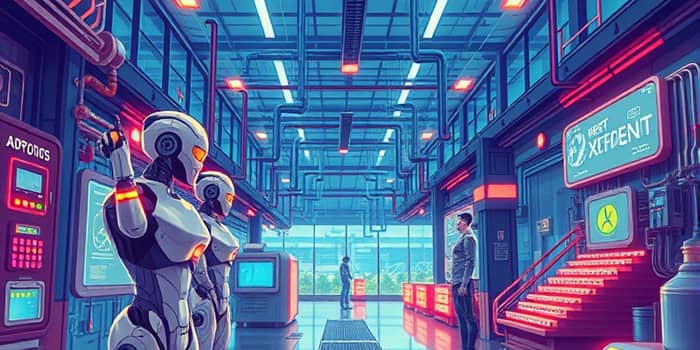
In 2026, manufacturing is undergoing a profound yet quiet, incremental transformation—a silent revolution powered by advanced materials, artificial intelligence, and sustainable practices. Far from the dramatic disruptions of the past, this new era is defined by subtle shifts that unlock hidden value in efficiency, resilience, and human collaboration. Across factories worldwide, these innovations are reshaping shop floors, supply chains, and business models, forging a path toward a more competitive, eco-friendly future.
The backbone of this silent revolution lies in the development of dual-phase stainless steels like UNS S32101, which combine austenite and ferrite microstructures for unmatched strength and corrosion resistance in harsh environments. From coastal infrastructure to chemical processing plants, these alloys extend equipment lifespan, cut maintenance costs, and enhance safety.
In parallel, semiconductor materials are leaping forward. Wide-bandgap compounds such as GaN and SiC power electric vehicles, 5G networks, and renewable-energy systems with higher efficiency and lower losses. Emerging two-dimensional materials like MoS₂ and graphene—with electron mobility ten times that of silicon—promise ultra-fast processing and novel sensor capabilities, though atomic-scale fabrication remains an ongoing challenge.
Artificial intelligence is no longer an add-on; it is native to modern control systems. Generative AI embedded in PLC platforms—such as Siemens TIA Portal and Omron Sysmac Studio—can read text specifications, produce structured logic code, debug errors, and optimize energy and PID parameters autonomously. Predictive-maintenance algorithms monitor vibration, temperature, and current data to anticipate equipment failures and schedule interventions before downtime occurs.
The result? Manufacturers report up to 20% improvements in throughput and substantial waste reduction, in line with McKinsey’s 2023 findings. Leading solutions like Siemens Industrial Copilot, developed with Microsoft, seamlessly auto-document code, enforce PLCopen standards, and support self-learning function blocks for continuous process refinement.
In the realm of robotics, collaboration is key. Heavy-duty cobots now handle payloads exceeding 50 kilograms, equipped with capacitive skin sensors and 3D vision to work safely alongside human teammates without physical barriers. This new generation of collaborative machines transforms logistics, assembly, and material handling, unlocking unprecedented flexibility.
As robots take on repetitive heavy tasks, human roles evolve into high-skill positions: system supervisors, data analysts, and maintenance strategists. This shift not only boosts job satisfaction but also nurtures a more resilient and creative workforce.
Environmental stewardship is no longer optional; it is integral to competitive advantage. Manufacturers are deploying energy-efficient technologies and water-recycling systems to shrink their ecological footprints. Scrap metal is re-melted in exact proportions to achieve desired alloy properties, while life-cycle assessments guide material sourcing and product design.
AI-driven energy optimization adjusts motor torques, cam profiles, and HVAC operations in real time, minimizing consumption across production cycles. By embracing circular-economy principles, companies not only comply with tightening regulations but also win consumer trust and long-term cost savings.
The traditional automation pyramid is dissolving. Unified Namespace architectures powered by OPC UA and MQTT Sparkplug B break down data silos, enabling seamless communication among sensors, drives, robots, and enterprise systems. This holistic data ecosystem supports precise digital twins that mirror physical processes, allowing virtual commissioning, optimization, and scenario testing without halting production.
Edge computing nodes preprocess massive data streams locally, while cloud platforms handle advanced analytics and global coordination. In semiconductor fabs, innovations like EUV lithography and gate-all-around transistor designs further drive miniaturization, energy efficiency, and yield improvements, reinforcing the digital infrastructure’s role in every stage of manufacturing.
The United States is at the forefront of a manufacturing renewal, fueled by an $86 billion investment supercycle. Highlights include an $11 billion Texas Instruments silicon wafer fab in Utah and a $50 billion CHIPS and Science Act fund dedicated to domestic semiconductor production. EV battery and solar-cell gigafactories from Northvolt and Hanwha Q Cells in Quebec underscore North America’s bid for energy and supply-chain independence.
These investments pay dividends in national competitiveness, job creation, and technological leadership, positioning manufacturers to thrive amid global uncertainty.
While challenges remain—fabrication complexity at the atomic scale, gas purity in semiconductor processes, and workforce retraining—the trajectory is clear. The silent revolution in manufacturing is less about sweeping upheaval and more about continuous, human-centered progress. By embracing advanced materials, cognitive automation, and sustainable practices within a unified digital framework, companies can build resilient ecosystems that thrive amid change.
In this new era, factories become living entities: adaptive, efficient, and responsive to both market demands and environmental imperatives. The real heroes are the people who guide this transformation, evolving from machine operators to visionary orchestrators of technology. Together, they are shaping a future where innovation whispers rather than shouts, yet echoes across every corner of the global economy.
References