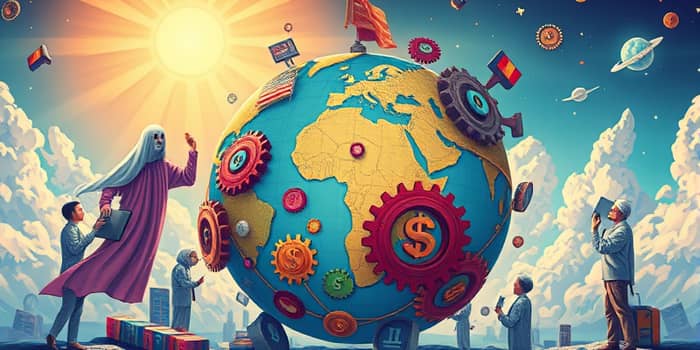
Behind every headline announcing growth figures or inflation trends, there are countless decisions and negotiations unfolding in boardrooms, central banks, and multilateral forums. These hidden forces guiding global markets are the unseen architects shaping the economic destiny of nations. Understanding their craft empowers us to navigate uncertainty and champion effective collaboration.
As we peer into the economic horizon for 2026, forecasts diverge widely. The IMF predicts a solid 3.3 percent expansion, while UNCTAD offers a more cautious 2.7 percent estimate—below the pre-pandemic average of 3.2 percent. The World Economic Forum cites 3.1 percent, and Deloitte optimistically projects 4.5 percent, assuming vigorous fiscal stimulus.
This variance reflects differing assumptions on policy choices, external shocks, and geopolitical tensions. To visualize these projections, consider the following summary:
Advanced economies are grappling with the highest debt levels in a century, yet many governments plan fresh stimulus measures. Some proposals include direct payments funded by tariffs, while others target defense or industrial spending. Postponing difficult fiscal reforms until 2027 risks saddling future generations with higher borrowing costs.
To restore fiscal credibility, policymakers must:
After years of quantitative easing, central banks are engaging in the delicate art of unwinding central bank balance sheets. The Bank of Japan and European Central Bank are accelerating bond sales, while the US Federal Reserve and Bank of England signal a more cautious pace. This delicate dance raises a critical question: if central banks step back, who will absorb the flood of government debt?
Specific trajectories vary:
The Bank of Japan aims to nudge policy rates from 0.5 to 1 percent by year-end, reaching a long-term neutral level. The ECB, having cut rates from 4.5 to 2.15 percent, is now in a wait-and-see mode. Meanwhile, the Reserve Bank of Australia expects inflation to return to target only in late 2026.
Global trade policies are in flux as nations reassess openness versus strategic self-reliance. In the United States, new Section 232 tariffs on semiconductors and critical minerals exemplify a shift toward protectionism. Other countries face pressure to reciprocate, risking a cascade of trade barriers that could stifle innovation and raise consumer prices.
As the USMCA six-year review approaches, Mexico’s investors remain cautious. Although most treaty concessions are expected to persist, uncertainty over potential revisions weighs heavily on manufacturing and nearshoring plans.
The vision of seamless, low-cost cross-border payments is colliding with reality. Rather than a unified system, a patchwork of competing networks is emerging, driven by national tokenization efforts. China and India have launched live rails, while Brazil, Russia, and others pilot alternative networks.
This fragmentation challenges the United States’ G20 presidency, which seeks to refresh the global payments roadmap. Will major economies align behind common standards, or must they adapt to parallel systems where non-dollar currencies and regional blocs take precedence?
China: Forecasts range from 4.5 percent by the IMF to as low as 2.5 percent in some private analyses. Authorities are tackling overcapacity in steel, cement, and solar panels under an “anti-involution” drive and seeking to bolster consumer demand as external markets soften.
United States: With significant trade barriers already in place, the US retains room for rate cuts—up to 375 basis points if conditions warrant. The interplay between fiscal support and monetary easing will shape growth and inflation dynamics.
European Union: Germany introduces energy relief in January 2026 and an investment package, but bureaucratic delays temper expectations. Reducing deficits below 3 percent of GDP will require either higher taxes or spending cuts, straining households and business confidence.
Mexico: As tariff uncertainty recedes, GDP growth is projected at 1.6 percent. Nearshoring and construction stand to benefit, supported by anticipated central bank rate cuts from 7 to 6.5 percent.
Argentina: After two years of stabilization, the country enters 2026 on firmer ground. Continued fiscal discipline and structural reforms aim to rein in inflation and attract investment, leveraging rich resource endowments.
Australia: A robust recovery since mid-2024 has improved capacity utilization, yet productivity growth remains a long-term challenge. Inflation is not expected to fully subside until late 2026.
UNCTAD warns that without stronger policy coordination, the risk of a persistently low-growth path looms large. Key priorities include:
Meanwhile, competition in technology and AI continues to accelerate. Governments must balance rapid investment with realistic expectations to avoid costly overreach.
Global inflation should ease overall, though US price pressures may subside more slowly. Policymakers debate the steady state equilibrium—the optimal rate that balances growth, inflation, and financial stability.
Despite resilience, several downside risks could derail the recovery. Being aware of these threats helps stakeholders prepare and adapt:
As these unseen architects labor behind the scenes, their choices will determine whether we build a resilient, inclusive global economy or succumb to fragmentation and stagnation. By fostering bold multilateral cooperation, embracing innovation responsibly, and maintaining fiscal discipline, we can ensure that economic policies serve not just narrow interests, but the broader aspirations of people worldwide.
In 2026 and beyond, let us champion transparency, dialogue, and shared purpose. Together, we can transform unseen influence into tangible progress—embodying the highest ideals of global partnership and prosperity.
References