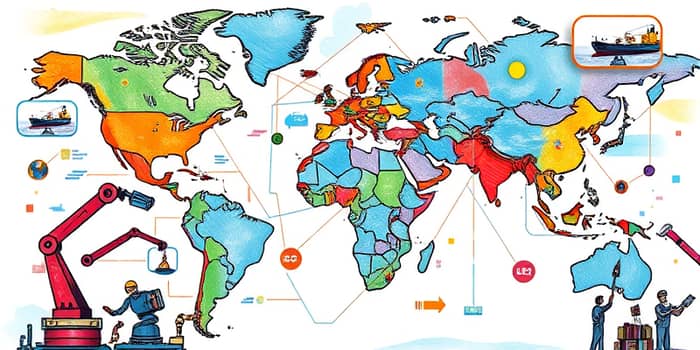
Global value chains (GVCs) have ushered in a new era of economic collaboration, where production is no longer confined to one nation. Instead, fragment production across borders harnesses the collective strengths of design hubs, resource providers, manufacturing centers, and distribution networks worldwide.
At its core, a global value chain dismantles the traditional supply chain model by emphasizing value addition at each production stage. From initial concept and design to final delivery and after-sales support, each phase may take place in different countries, exploiting specialized expertise and comparative advantages.
Intermediate goods and services travel back and forth across borders, reflecting the reality that a modern smartphone may source minerals from one continent, assemble in another, and undergo quality testing somewhere else altogether.
Historically, multinational enterprises (MNEs) managed vertically integrated operations, controlling every step from raw materials to retail. As trade liberalized, firms began outsourcing noncore tasks, birthing the first global supply chains. Over time, these matured into sophisticated GVCs, spotlighting harnessing global specialization and expertise.
By 2026, GVCs accounted for a significant share of international trade, global GDP, and employment in both advanced and developing economies. Yet the COVID-19 pandemic exposed vulnerabilities, prompting firms and governments to reassess their dependence on distant suppliers.
GVCs deliver remarkable advantages:
Despite these gains, challenges persist:
As we look toward 2026, digitalization and AI stand at the forefront of GVC innovation. Industrial and manufacturing digital transformation spending is projected to reach US$224.7 billion globally, a 13.8% year-on-year increase.
Leading sectors include chemicals (US$28.5B), food & beverage (US$22.8B), and electronics (US$21.3B). Investments focus on operational flexibility, quality control, and intelligent tariff management.
In a recent survey, 93% of COOs at manufacturers with revenues over US$1B plan to increase AI and digital technology investments over the next five years. Smart manufacturing, encompassing automation, data analytics, sensors, and cloud integration, is expected to absorb at least 20% of operational budgets in 80% of these firms.
Beyond cost and efficiency, resilience has become paramount. Agentic AI mitigating sourcing risks allows firms to model scenarios in real time and reroute supply flows when disruptions occur. Predictive supply chain intelligence is embedding resilience into daily operations.
Sustainability is no longer a peripheral concern. Companies are implementing circular manufacturing, carbon capture systems, and renewable energy integration to meet mounting regulatory demands on emissions disclosure by 2027.
Automation and AI introduce profound changes to labor requirements. Governments are investing over US$20 billion to retrain workers, reconfigure workflows, and establish robust safety protocols for human-robot collaboration.
As Industry 4.0 matures, the cultural and systemic shift toward resilience depends on people. People drive AI adoption speed and impact, ensuring technology complements human ingenuity rather than replacing it.
Developing suppliers can ascend the value chain through a continuum of upgrading pathways:
Policy measures must foster open trade, encourage foreign investment, and support workforce development. The World Bank and UNCTAD advocate regional integration, innovation hubs, and targeted subsidies to help emerging economies capture greater GVC value.
The journey of global value chains continues to unfold, shaped by technological advances, shifting political landscapes, and evolving consumer demands. By embracing digital transformation, prioritizing resilience, and nurturing human capital, businesses and nations can co-create a more inclusive and sustainable production ecosystem.
Ultimately, the value chain revolution is a testament to our collective capacity to transcend borders and collaborate at an unprecedented scale. It challenges us to think creatively about how we design, produce, and deliver value, ensuring that the benefits of globalization are shared equitably and responsibly.
References