Global wealth inequality is one of the most pressing issues of our time, presenting a challenge that touches every aspect of human society. From access to education and healthcare to the stability of political systems, the extreme concentration of economic resources shapes the lived experiences of billions. As we stand at a crossroads, understanding the forces driving these disparities and the potential pathways toward a more equitable world is essential.
In this article, we explore the statistics, historical trends, and structural mechanisms behind wealth inequality. We also offer practical steps that individuals, communities, and policymakers can adopt to foster meaningful change.
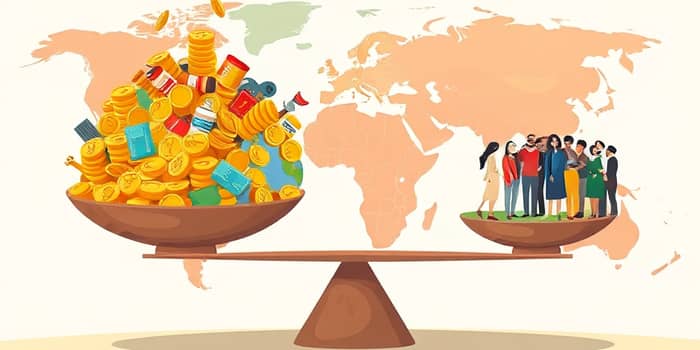
At the global level, the gap between the richest and the poorest has reached unprecedented levels. According to recent data, the top 10% own three-quarters of all global wealth, while the bottom 50% retain a mere 2%. Even more startling, the top 1% controls 37% of global wealth—a share that far exceeds the combined wealth of the entire bottom half of the world population.
Income inequality, while serious, is less extreme but still remarkably uneven. The upper decile collects over half of global income, leaving only 8% for the bottom half of earners. However, wealth disparities eclipse these income gaps: even in regions with relatively lower income inequality, such as Europe, the wealth of the top 10% can be nearly two hundred times that of the bottom 50%.
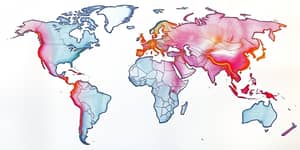
Different regions exhibit strikingly varied levels of inequality, shaped by history, policy, and economic structures. In North America and Oceania, and the Middle East and North Africa, wealth divides exceed 520 to 1 between the richest and the poorest. In contrast, parts of Asia show lower but still significant gaps.
Below is a comparison of wealth gap ratios by region, illustrating how stark these differences can be:
Over the past four decades, income shares for the richest decile have grown in nearly every country. Between 1980 and 2020, nations such as India, China, and the United States saw substantial increases in the proportion of national income going to their wealthiest citizens. This rise in income shares has accompanied a surge in the fortunes of billionaires, whose wealth grew by over 16% in a single year, reaching a record $18.3 trillion globally in 2025.
The expansion of wealth at the very top has far outpaced that of the middle and lower tiers. The share of global wealth held by the top 0.001% climbed from 3.8% in 1995 to 6.1% in 2025, illustrating how the ultra-wealthy have accelerated their accumulation of assets.
The architecture of the global financial system plays a pivotal role in reinforcing these inequalities. Each year, approximately 1% of global GDP flows from poorer to richer nations through net income transfers—three times the volume of development aid. These transfers stem from higher yields on assets held by wealthier countries and lower interest rates on debt in developing economies.
Within regions, the top 1% often holds more wealth than the bottom 90% combined, showcasing the concentration of financial power at every level. The mechanisms that facilitate these flows include preferential lending terms, tax regulations, and investment vehicles that disproportionately benefit those with existing capital.
While the data on wealth inequality can feel overwhelming, there are concrete steps that can drive progress toward a more balanced economy. These efforts must span policy reforms, institutional changes, and grassroots movements.
Governments and international bodies can consider:
Individuals and communities also have a role to play:
Beyond policy and activism, innovation in financial technologies and community-driven cooperatives offers hope. Microfinance, digital banking for underserved areas, and local currency models can democratize access to capital and reduce reliance on systems that favor the already wealthy.
In the face of such deep-seated disparities, it is vital to maintain a spirit of collaboration and collective effort. While the challenges are immense, history shows that sustained advocacy and constructive policy can shift economic outcomes. The widening of opportunity often begins with small, targeted actions that grow into broader movements.
By uniting to address the root causes of wealth concentration and by supporting solutions that uplift the many rather than the few, we can reshape the global economy. Each step toward equitable resource distribution not only benefits individuals but also strengthens communities, fosters stability, and unlocks human potential on a grand scale.
Ultimately, the quest for economic justice is a shared journey that calls upon our empathy, creativity, and resolve. With informed action and unwavering commitment, a future characterized by balanced prosperity is within reach.
References